Solvent Recovery Unit | Activated Carbon Vacuum Regeneration (T+VSA) | DEC.SRU_RTV™
DEC.SRU_RTV™, Vacuum Regenerated Solvent Recovery Units are based on activated carbon adsorption, with a combined desorption process, by hot inert gas (N2, nitrogen) and vacuum regeneration (T+VSA process). The Vacuum Regenerated Solvent Recovery Units are the ideal VOC treatment technology for recovering solvents for low SLA volumes, ideally with steady medium-high concentrated VOC streams, discharged from storage tanks, vents, ships, railcars or truck tankers.
Is DEC.SRU_RTV™ the Right Fit for Your Stream?
DEC.SRU_RTV™ is intended for selected low-airflow, medium-to-high VOC concentration applications, including vapors from storage tanks, vents, ships, railcars and truck tankers. For breathing-loss vapor recovery specifically from tank vents, see DEC.SRU_VRU™ • Vapor Recovery Unit; for the storage tanks themselves, see DEC.SST™ • solvent storage tanks. If your stream falls outside this envelope, DEC's engineering team can point you to a better-suited regeneration process (see below).
How Does T+VSA Solvent Recovery Work?
Solvent recovery systems, based on activated carbon adsorption, vacuum regenerated, are treating variable volumes of gaseous effluent (typically 500 ÷ 15.000 Nm³/h); the regeneration of the adsorption media (activated carbon) is made under vacuum [coupling different processes as TSA (thermal swing) + VSA (vacuum swing), under hot N2 (nitrogen)], determining this technology to be ideal for the processing of low SLA (volumes) and steady medium-high concentration VOC streams: in case of different applications (for size and/or concentrations), take a look at the inert gas (nitrogen, N2) regeneration process DEC.SRU_RSG™ or the steam regeneration process (DEC.SRU_RSV™) or alternatively cryocondensation process (DEC.SRU_RSC™).
From Solvent-Laden Air to Recovered Solvent
Activated Carbon Adsorption
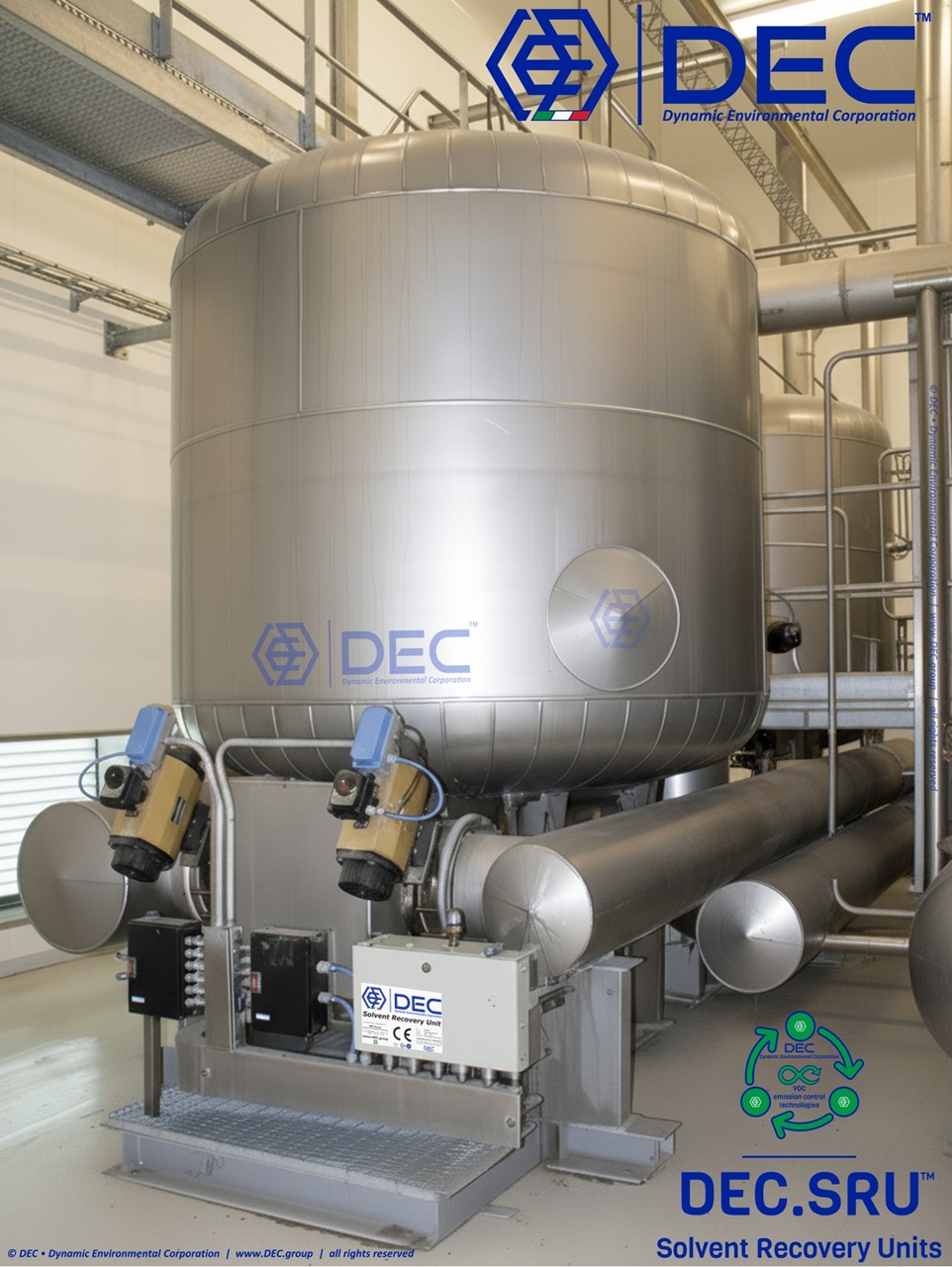
The solvent recovery unit is composed by two or more activated carbon adsorbers which alternate the adsorption and regeneration phase. The Solvent Laden Air (SLA), once treated (filtered and conditioned), passes through the activated carbon bed of the adsorber that is in the adsorption phase: the carbon adsorbs the solvent and the air deriving from this process is cleansed. In the next phase, we start desorbing the solvent under high vacuum.
Thermal + Vacuum Regeneration
Desorption is carried out by a combined process of hot inert gas (N2, nitrogen) and vacuum regeneration — the T+VSA process. Coupling Thermal Swing Adsorption (hot nitrogen) with Vacuum Swing Adsorption lets the bed regenerate at comparatively low temperatures, which is what makes this process well suited to low SLA, steady medium-to-high concentration streams.
 |
 |
Solvent Condensation and Recovery
Thanks to an efficient solvent condensation system, the recovered product is sent back to production tank(s). Non condesible stream is recycled back to adsorption system. We must consider that water comes from the partial adsorption of humidity in the flow to be treated: systems for correction of relative humidity (DEC.RHC™) could be implemented for particular process conditions. Further recovered VOC drying processes may be applied: check available Advanced Dehydration Modules (DEC.ADM™).
When Is Vacuum Regeneration Appropriate?
T+VSA couples thermal swing (hot nitrogen) with vacuum swing regeneration, which suits low-airflow, steady medium-to-high concentration streams. For different flow sizes or concentrations, DEC also offers inert gas (nitrogen) TSA regeneration, steam TSA regeneration, and direct condensation/cryocondensation; DEC's engineering team selects the most suitable process based on the application.
| Technology | Regeneration Method | Best Fit |
|---|---|---|
| DEC.SRU_RTV™ | Hot nitrogen (TSA) + vacuum (VSA) — T+VSA | Low SLA, steady, medium-to-high concentration streams |
| DEC.SRU_RSG™ | Hot inert gas (N2) — TSA | Applications better suited to conventional inert-gas thermal regeneration |
| DEC.SRU_RSV™ | Steam — TSA | Applications better suited to steam thermal regeneration |
| DEC.SRU_RSC™ | Direct condensation / cryocondensation | Applications better suited to direct condensation |
Operational Considerations
Vacuum Regenerated Solvent Recovery Units (T+VSA) provide significant advantages for selected VOC recovery applications, particularly where low regeneration temperatures, compact layouts and high desorption efficiency are required. Compared with conventional Thermal Swing Adsorption (TSA) systems, however, vacuum regeneration introduces additional mechanical complexity, maintenance requirements and operational considerations that should be evaluated during technology selection and lifecycle planning. DEC's Diagnostic Maintenance Program (DEC.DMP™) and Safety Training Center (DEC.STC™) are built specifically to help plants absorb these extra requirements.
| Consideration | What It Means for Your Plant |
|---|---|
| Higher Maintenance Requirements | Vacuum pumps, condensers, knock-out vessels, seals, valves and instrumentation need regular preventive maintenance to hold design vacuum levels and desorption efficiency. |
| Specialized Technical Expertise | Overhaul, rotor inspection, bearing/seal replacement, leak testing and shaft alignment call for personnel trained in vacuum technology, not standard blower-service skills. |
| Certified Vacuum Pump Maintenance | Major overhauls are generally recommended to be carried out by factory-authorized or certified service workshops (see DEC.MRO™), to protect performance and warranty. |
| Higher Lifecycle Maintenance Costs | Precision seals, bearings, lubrication systems and control valves typically need more frequent inspection and higher-value parts than blower-based TSA systems. |
| Longer Downtime During Major Maintenance | Major pump work often means full removal and shipment to a certified service centre, unless redundant vacuum packages are installed. |
| Sensitivity to Process Conditions | Condensable vapours, liquid carry-over, particulates and corrosive or polymerising compounds can wear pumps faster without good upstream separation and filtration. |
Vacuum Integrity and Air Ingress
Because the regeneration circuit operates under sub-atmospheric pressure, any loss of mechanical integrity allows atmospheric air to be drawn into the process. Potential ingress points include flange gaskets, valve seats, actuator stem seals, mechanical seals, instrumentation connections, threaded fittings, expansion joints and maintenance access points. Even relatively small leaks may reduce the achievable vacuum level, extending regeneration time, reducing solvent desorption efficiency and increasing overall energy consumption.
Instrumentation and Control
T+VSA systems generally require additional instrumentation for vacuum control, oxygen monitoring, leak detection, pressure regulation and automatic sequencing. This increases the complexity of both the control architecture and preventive maintenance programme when compared with conventional thermal regeneration systems.
Safety Considerations
Because the regeneration circuit runs under vacuum, DEC pays particular attention to oxygen ingress, leak detection and mechanical integrity across the operating life of a T+VSA installation.
| Safety Consideration | Why It Matters |
|---|---|
| Oxygen Ingress | Air ingress introduces oxygen into a circuit that normally contains solvent vapours and inert regeneration gases; depending on conditions, oxygen enrichment (flagged by the oxygen analyzer) may require immediate cycle interruption, automatic shutdown and established safety procedures before restart. |
| Leak Detection | Vacuum leaks often produce no visible external emission, unlike positive-pressure leaks; diagnosis may need sectional isolation, vacuum decay testing or helium leak detection, and can require extended production stoppages to locate and repair. |
| Mechanical Integrity Programme | Long-term vacuum integrity needs systematic inspection of gasket condition, bolting torque, valve sealing performance, expansion joint integrity, instrument connections and periodic vacuum performance testing throughout the plant's operating life. |
Advanced safety and fire prevention, detection and suppression systems are available as options: check for our DEC.FPS™ process control modules. DEC's health & safety practices are aligned with our site-wide ISO 45001 occupational health & safety programs.
Explore DEC's Safety & Compliance Systems
Lifecycle and Maintenance
Although Vacuum Regenerated SRUs can offer important process advantages for selected applications, their overall lifecycle performance depends on rigorous preventive maintenance, qualified technical personnel, preservation of vacuum integrity and appropriate operational management. These factors should be evaluated together with energy consumption, solvent recovery efficiency, maintenance costs and plant availability during the selection of the most suitable solvent recovery technology.
High-performance industrial vacuum equipment is manufactured by a relatively limited number of specialized suppliers worldwide, so lead times for complete vacuum units, original spare parts and certified repair services may be longer than for conventional process equipment; strategic spare-part inventories and long-term maintenance planning are recommended where maximum plant availability is critical. Depending on their technical characteristics, pumping capacity, ultimate vacuum performance and intended end use, certain industrial vacuum pumps and associated equipment may also be subject to export control regulations in some jurisdictions — international projects may require export classification, end-user declarations and licence assessments during project planning, procurement and logistics.
DEC Support Across the System Lifecycle
Layout
DEC Solvent Recovery Units (SRUs) are available in both skid modular layout (DEC-SMS™ • Smart Modular System, pre-built and pre-tested at our workshops) or in full customizable version (DEC-CBS™ • Custom Built System, with on-site erection).
Industrial Applications
DEC.SRU_RTV™ units recover solvent from a variety of low-airflow source streams: storage-tank vapor spaces, process vents, and loading/unloading operations for ships, railcars and truck tankers, wherever the VOC concentration is steady and moderate-to-high rather than large, dilute or highly variable. Browse DEC's solvent recovery case studies for recovered-solvent projects across industries.
Conclusion
If you are looking for a reliable and efficient solvent recovery unit, DEC.SRUs™ (Solvent Recovery Units) are the right and best option: DEC.SRUs™ are the most advanced and reliable Solvent Recovery Units on the market, with processes, configurations and options to meet the needs of different applications, present and future challenges.
Ready to Start Your Project?
Contact Us
Reach our Technical Sales & Applications engineering team to discuss your VOC & HAP emission control requirements
FAQs • Frequently Asked Questions
Solvent Recovery | activated carbon | vacuum regeneration ♻️ DEC.SRU_RTV™
What is DEC.SRU_RTV™ and how does it recover solvent?
DEC.SRU_RTV™ is a Vacuum Regenerated Solvent Recovery Unit based on activated carbon adsorption, with desorption carried out by a combined process of hot inert gas (N2, nitrogen) and vacuum regeneration (T+VSA process). Solvent-laden air passes through an activated carbon bed that adsorbs the solvent; the bed is then regenerated under vacuum and the recovered solvent is condensed and sent back to production tanks.
How much air can a single DEC.SRU_RTV™ unit handle, and what kind of VOC stream is it built for?
DEC.SRU_RTV™ handles gaseous effluent flows in the 500 to 15,000 Nm3/h range per unit, with higher throughput achievable by combining multiple modules. It's best suited to low SLA (Solvent Laden Air) applications where the VOC stream is steady and moderately-to-highly concentrated, rather than large, dilute or highly variable flows.
How does vacuum regeneration (T+VSA) differ from DEC's other SRU regeneration processes?
T+VSA couples thermal swing (hot nitrogen) with vacuum swing regeneration, which suits low-airflow, steady medium-to-high concentration streams. For different flow sizes or concentrations, DEC also offers inert gas (nitrogen) TSA regeneration (DEC.SRU_RSG™), steam TSA regeneration (DEC.SRU_RSV™), and direct condensation/cryocondensation (DEC.SRU_RSC™); DEC's engineering team selects the most suitable process based on the application.
What maintenance does a T+VSA vacuum regeneration system require?
Vacuum regeneration systems require more specialized maintenance than conventional thermal regeneration: preventive maintenance of the vacuum pump package, personnel trained in vacuum technology, periodic leak detection and vacuum-integrity checks, and additional instrumentation for vacuum control, oxygen monitoring and automatic sequencing. Major vacuum pump overhauls are generally recommended to be carried out by factory-authorized service workshops.
Is DEC.SRU_RTV™ available as a modular skid or a custom-built system?
DEC.SRU_RTV™ units are available in both a skid modular layout (DEC-SMS™ • Smart Modular System, pre-built and pre-tested at DEC's workshops) and a fully customizable version (DEC-CBS™ • Custom Built System, with on-site erection).
Is pricing available for DEC.SRU_RTV™, and can I purchase a system directly?
DEC.SRU_RTV™ systems are custom-engineered, quote-based industrial equipment: there is no fixed list price, since each unit is sized and priced according to the customer's specific flow rate, solvent type, concentration and layout requirements. Contact DEC's Technical Sales & Applications engineering team to request a quote for your application.
DEC.WSE™ • Web Search Engine