Solvent Recovery Unit | Activated Carbon Steam Regeneration (TSA) | DEC.SRU_RSV™
Solvent Recovery Units, based on activated carbon adsorption, steam regenerated, are using a technology which has been proven in thousands industrial applications (mainly for mono solvent systems), treating variable volumes of gaseous effluent (2.000 ÷ 1.000.000 Nm³/h); steam is used for the regeneration of the adsorption media (activated carbon), determining this process to be ideal for the recovery of non water miscible solvents or for solvents which do not form azeotropic mixtures with water: in this case you have to apply the inert gas (nitrogen, N2) regeneration process DEC.SRU_RSG™
The Solvent Recovery Unit (SRU) is an advanced Air Pollution Control (APC) system designed to capture and recover volatile organic compounds (VOCs) from industrial process exhausts. This system utilizes the physical properties of high quality activated carbon to ensure high removal efficiency and resource circularity.
What Is DEC.SRU_RSV™?
DEC.SRU_RSV™ is a solvent recovery process based on activated carbon adsorption and steam regeneration in a Temperature Swing Adsorption (TSA) cycle. It is intended for selected solvent streams where steam regeneration and subsequent condensation and phase separation provide the required recovery performance.
How Does Steam-Regenerated Solvent Recovery Work?
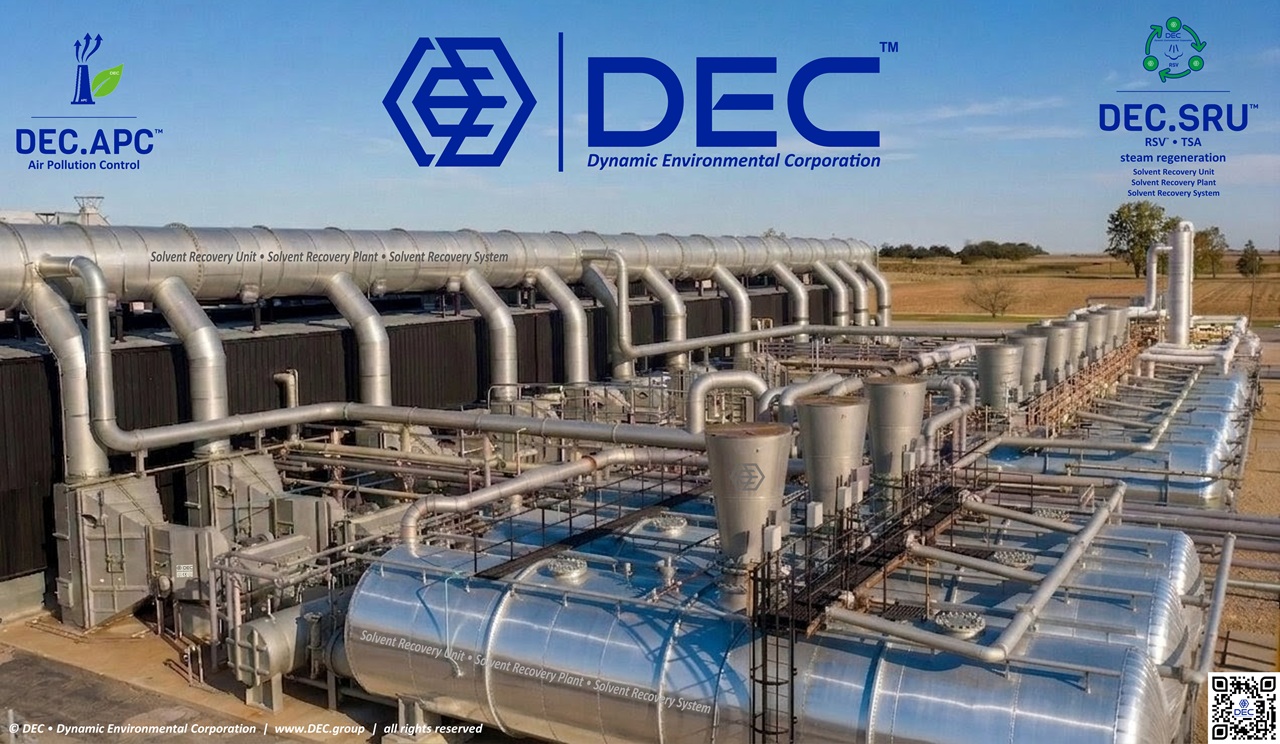
The solvent recovery unit is formed by two or more activated carbon adsorbers, that alternate an adsorption phase with a regeneration one. The Solvent Laden Air (SLA), once it has been treated (filtered and conditioned), passes through the activated carbon bed of the adsorber that is in the adsorption phase: the carbon adsorbs the solvent and the air comes out cleansed. In the next phase a low-pressure steam flow, transferring heat to the activated carbon bed, desorbs the solvent. After it has been condensed, the solvent is sent to a static separator (decanter) or distillation systems to separate the organic phase from the water.
This recovered solvent can then be directly reused, providing significant cost savings and reducing the environmental footprint of the facility.
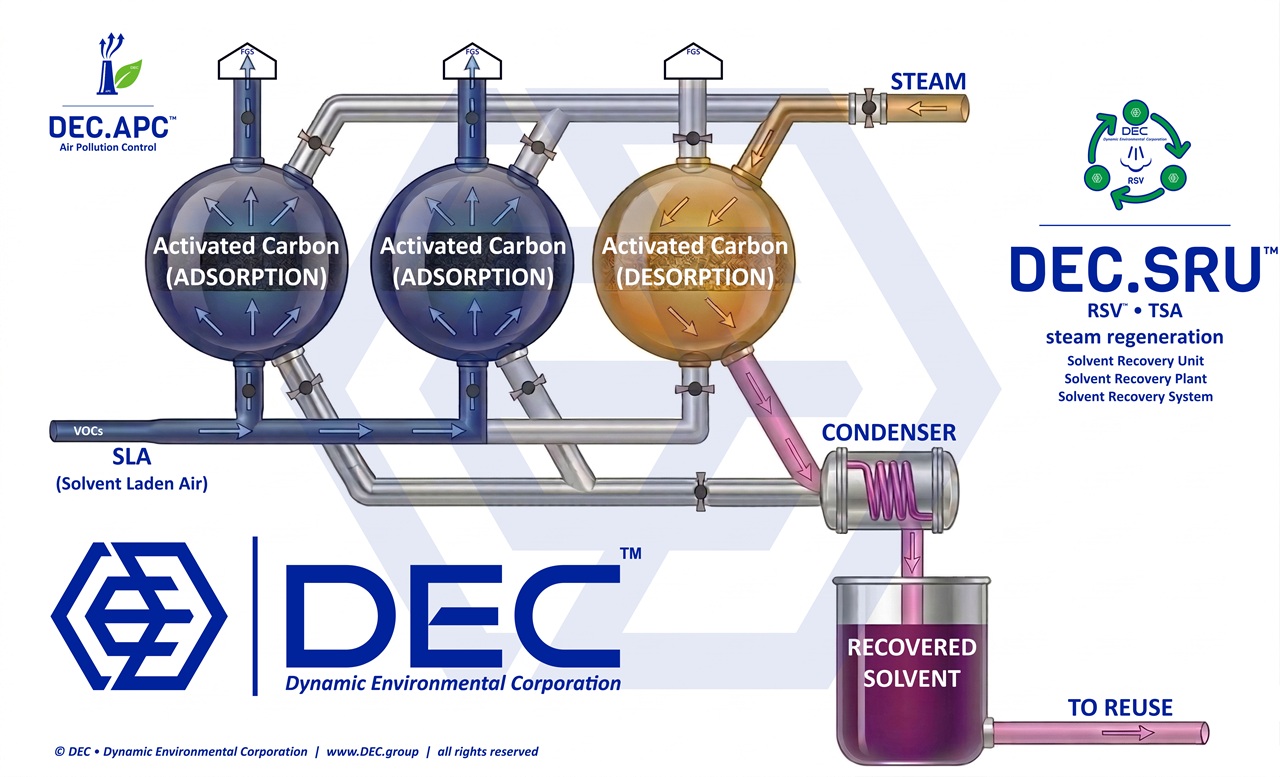
Here is a simplified overview of how an activated carbon Solvent Recovery Plant (SRU | SRP | SRS), steam regenerated, works ♻️ DEC.SRU_RSV™
- Filtration: the SLA is filtered to remove most of the particulate matter; this is important to prevent the particulate matter from clogging the adsorption bed in the static concentrator;
- Temperature control: the SLA is temperature-controlled to ensure that it is at the optimal temperature for adsorption; the optimal temperature will vary depending on the type of solvents being removed and the desired adsorption efficiency;
- Adsorption: the SLA is driven through the static concentrator to adsorb the solvents; the activated carbon in the static concentrator adsorbs the solvents, thanks to its large surface area and variable porous structure;
- Regeneration: once an AC adsorber is saturated with solvents, it is taken offline and regenerated; in-situ regeneration is used to (desorb) drive the solvents off of the activated carbon; a low-pressure steam flow is injected to transfer the heat to the activated carbon bed, desorbing the solvents.
- Condensation: the desorbed solvents are condensed in a heat exchanger, recovered in a tank;
- Separation: the condensate is processed through a static separator or distillation systems to divide the water phase from the organic one;
- Reuse: the recovered solvents can then be reused in the production process.
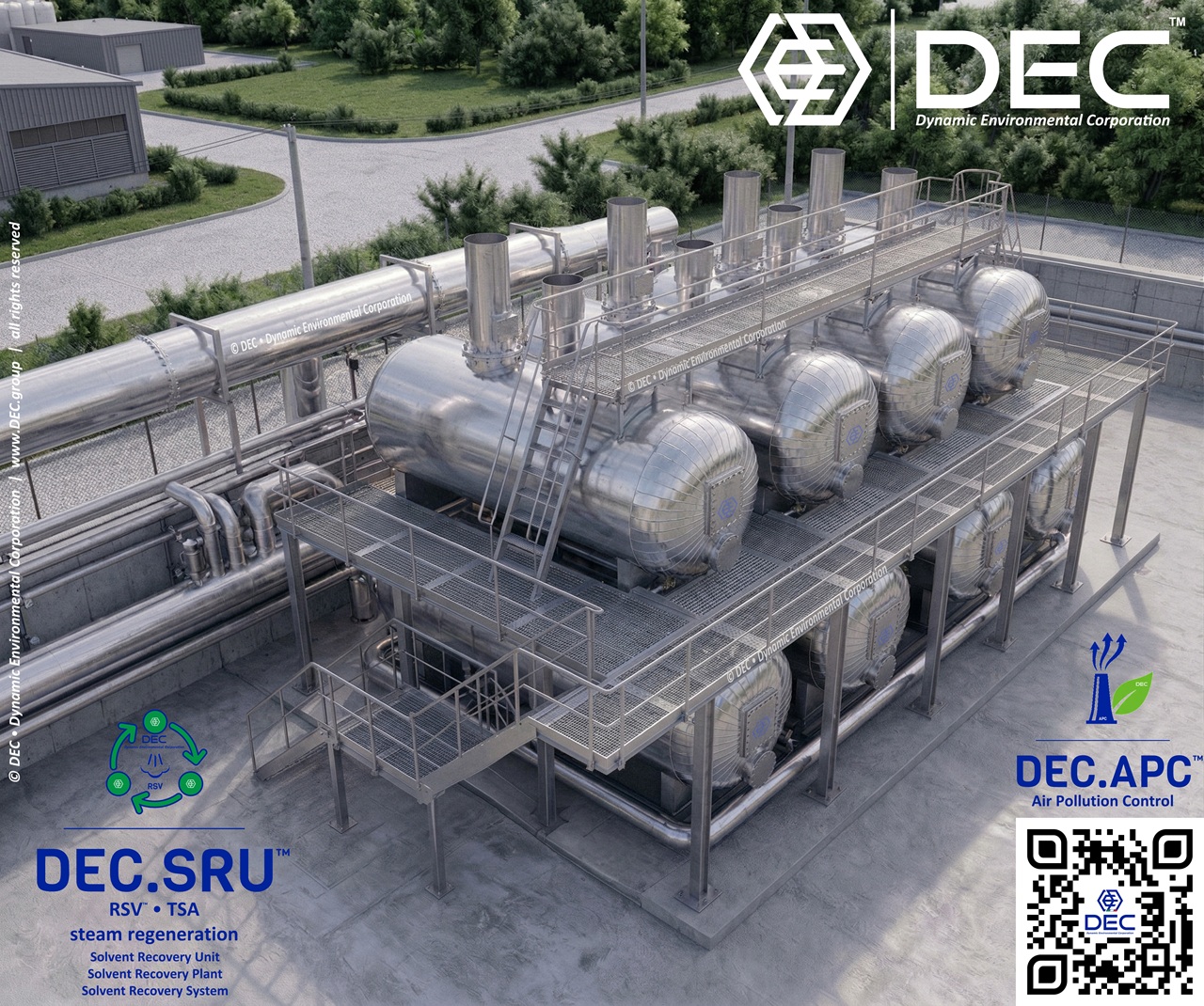
Advantages of Steam Regeneration
DEC designs each SRU to meet specific industrial requirements, ensuring maximum efficiency and compliance with global emission standards. Key features include:
- High Recovery Efficiency: systems typically achieve VOC recovery rates exceeding 99%;
- Energy Optimization: integrated heat recovery systems minimize steam consumption during the desorption cycle (ULP™ and WHR™ modules, ECOVAP™);
- Durability: the use of premium activated carbon (ACA™) ensures a long media lifespan and consistent performance;
- Safety: redundant sensors and automated control systems monitor LEL (Lower Explosive Limit) levels and temperature.
When Is Steam Regeneration the Right Choice?
DEC.SRU_RSV™ is suited to non-water-miscible solvents and solvent streams that do not form problematic azeotropic mixtures with water. Where water-miscible or azeotropic solvents require dry or anhydrous recovery, DEC.SRU_RSG™ nitrogen regeneration may be more appropriate; for selected low-airflow, medium-to-high concentration streams, DEC.SRU_RTV™ vacuum regeneration is another option. DEC selects the recovery technology from solvent chemistry, concentration, airflow, humidity, required emission limit, utilities and solvent-reuse objectives.
Engineering Considerations
Steam-regenerated solvent recovery requires coordinated design of activated-carbon adsorption, steam distribution, condensation and phase separation. DEC evaluates the solvent properties, solvent-laden air flow, concentration, humidity, required outlet emission and recovered-solvent specification before sizing the system and selecting the appropriate configuration.
DEC-SMS™ and DEC-CBS™ Configurations
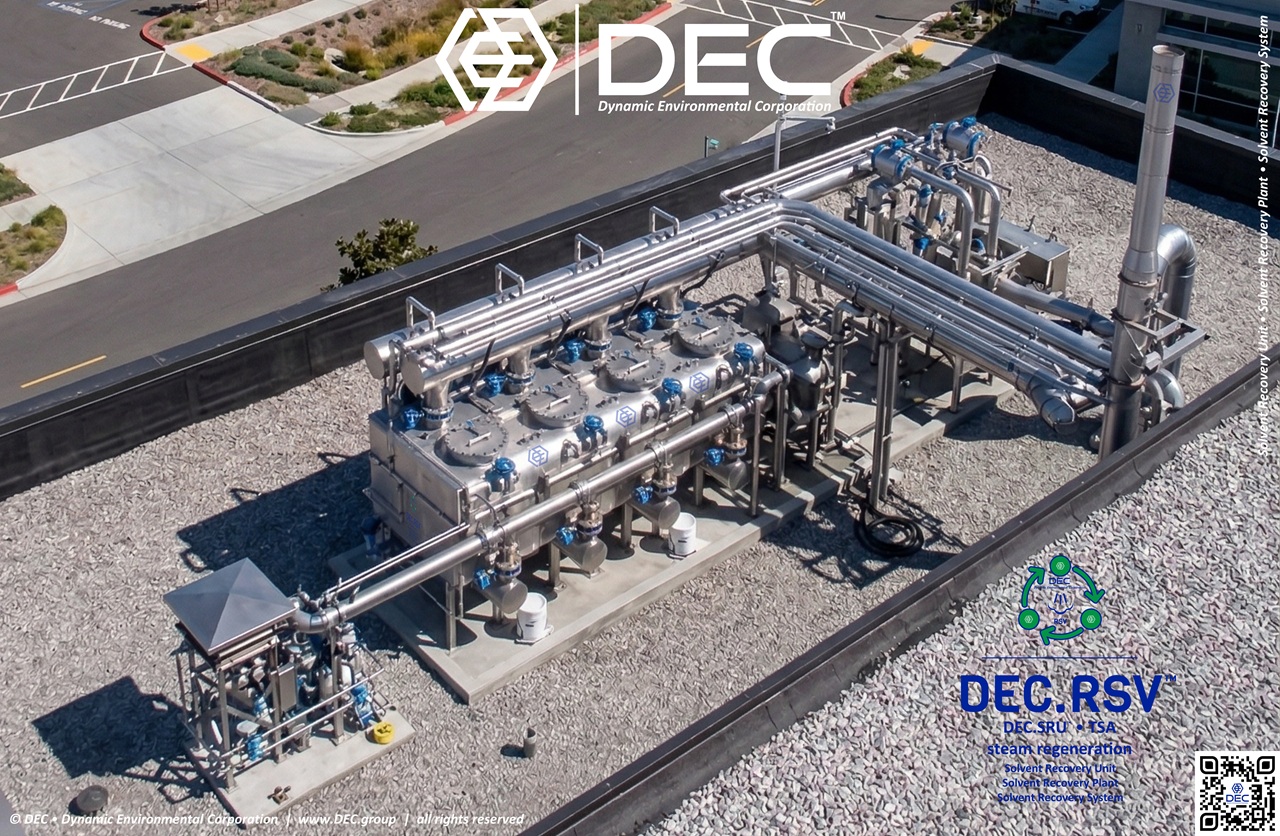
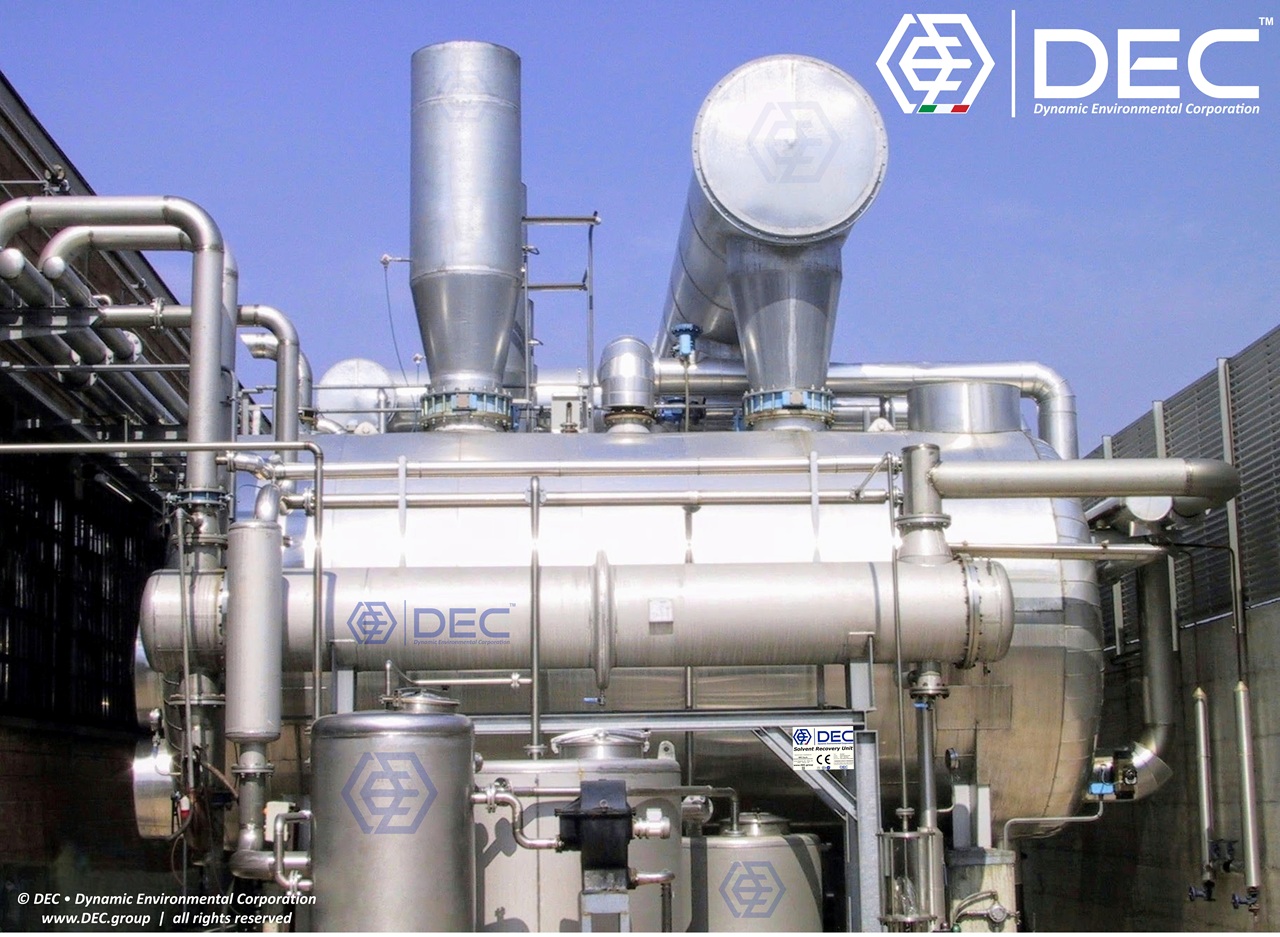
DEC Solvent Recovery Units (SRUs) are available in both skid modular layout (DEC-SMS™ • Smart Modular Systems, pre-built and pre-tested at our workshops) or in full customizable version (DEC-CBS™ • Custom Built Systems, with on-site erection).
 |
 |
Engineering and Project Consultation
If you are looking for a reliable and efficient solvent recovery unit, DEC.SRUs™ (Solvent Recovery Units) are DEC.SRUs™ are engineered with different recovery processes, configurations and options to meet specific application requirements.
Contact DEC for a free consultation: we can help you assess your needs and recommend the best SRU for your operation.
Ready to Start Your Project?
Contact Us
Reach our Technical Sales & Applications engineering team to discuss your VOC & HAP emission control requirements
FAQs • Frequently Asked Questions
Solvent Recovery | activated carbon | Steam regeneration ♻️ DEC.SRU_RSV™
What is the DEC.SRU_RSV™ process and how does it relate to solvent recovery?
The DEC.SRU_RSV™ (activated carbon Solvent Recovery Unit with steam regeneration) process is an industrial Air Pollution Control technology dating back to the 1920s. Steam is used to regenerate the activated carbon beds in a Temperature Swing Adsorption (TSA) cycle, desorbing the adsorbed solvents. This process is a well suited for handling variable Solvent-Laden Air (SLA) volumes and for non-water-miscible solvent streams, ensuring high solvent purity.
How does the Activated Carbon and Steam Regeneration (DEC.SRU_RSV™) solvent recovery system work?
The process involves several stages: 1. Filtration and cooling of the Solvent-Laden Air (SLA). 2. Adsorption: solvent vapors are adsorbed onto the activated carbon bed (DEC.ACA™). 3. Regeneration: once saturated, the bed is heated using saturated steam in a TSA cycle, causing solvent desorption. 4. Condensation: the solvent-rich desorbed stream is cooled in a condenser to get the solvent back into liquid form. 5. Purification: distillation (DEC.DST™) may follow to ensure high purity for reuse.
What's the difference between DEC-SMS™ and DEC-CBS™ configurations?
DEC offers the SRU_RSV™ process in two configurations: DEC-SMS™ (Smart Modular System), a skid-mounted unit pre-built and pre-tested at DEC's workshops, and DEC-CBS™ (Custom Built System), a fully customized unit engineered and erected on site to match specific plant requirements.
When should I choose steam regeneration (DEC.SRU_RSV™) instead of nitrogen (DEC.SRU_RSG™) or vacuum (DEC.SRU_RTV™) regeneration?
Steam regeneration (DEC.SRU_RSV™) is best suited for non-water-miscible solvents that do not form azeotropic mixtures with water. For solvents that are water-miscible or would form an azeotrope with water, DEC recommends the inert gas nitrogen regeneration process (DEC.SRU_RSG™) or, for temperature-sensitive solvents, the vacuum regeneration process (DEC.SRU_RTV™).
Is pricing available for DEC.SRU_RSV™, and how do I get a quote?
DEC.SRU_RSV™ systems are custom-engineered, quote-based industrial equipment, so there is no fixed list price. Each system is sized and priced individually once DEC's engineering team has evaluated the customer's solvent, throughput, site utilities and target emission limit. Contact DEC's Technical Sales & Applications engineering team for a free consultation and a proposal.
DEC.WSE™ • Web Search Engine