Industrial Solvent Recovery Units, Systems & Plants
DEC.SRU™
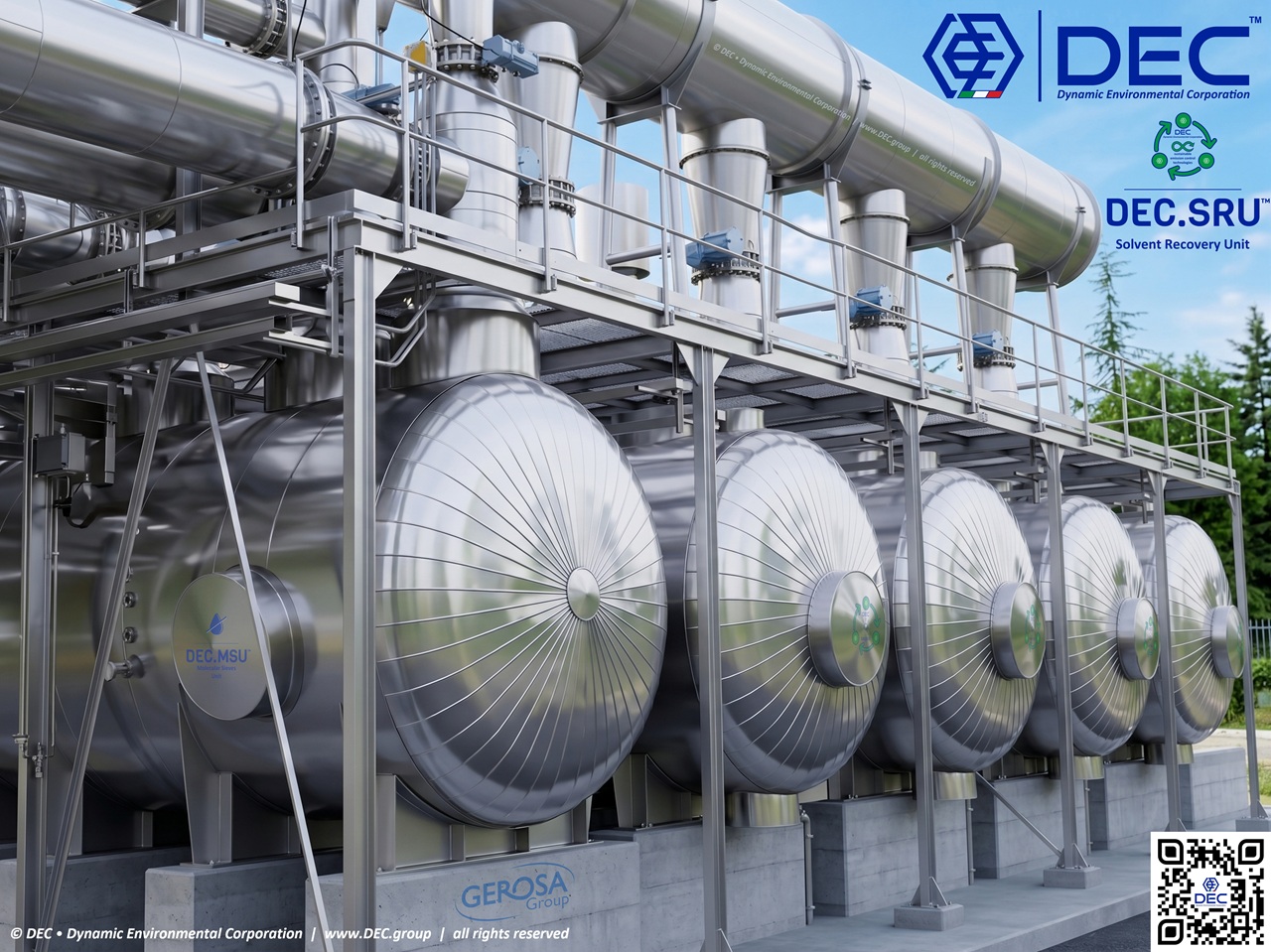
DEC designs and engineers industrial solvent recovery systems for capturing VOC solvents from solvent-laden process air and recovering them for reuse. DEC.SRU™ Solvent Recovery Units use adsorption, regeneration and solvent condensation technologies to reduce VOC emissions while recovering valuable solvents from industrial processes.
Depending on solvent chemistry, exhaust conditions, required emission limits and recovery objectives, DEC.SRU™ can be configured with nitrogen regeneration, steam regeneration, vacuum regeneration or direct condensation.
For detailed engineering guidance on solvent recovery, including adsorption, activated carbon selection, regeneration technologies, solvent compatibility, safety, economics and emissions compliance, see the Solvent Recovery Unit (SRU) Engineering Guide.
DEC.SRU™ Quick Facts
- Terminology
- Solvent Recovery Unit (SRU), Solvent Recovery Plant (SRP), Solvent Recovery System (SRS)
- Core technology
- Activated carbon adsorption & desorption, thermal or vacuum regeneration, solvent condensation
- Process Configurations
- nitrogen (DEC.SRU_RSG™), steam (DEC.SRU_RSV™), vacuum (DEC.SRU_RTV™), direct condensation (DEC.SRU_RSC™)
- Layout
- DEC.SRU-SMS™ modular, DEC.SRU-CBS™ custom-built, e-SRU™ full-electric
- Pricing
- Custom-engineered, quote-based — request a quote
- Track record
- Roots to the 1920s, 2,500+ projects delivered
What Is Industrial Solvent Recovery?
Industrial solvent recovery is the process of capturing solvent vapors from process exhaust air and recovering the solvents for reuse instead of destroying them. In an industrial solvent recovery system, solvent-laden air is treated by adsorption, typically using activated carbon, followed by regeneration of the adsorbent and condensation of the recovered solvent.
Solvent recovery can reduce VOC emissions while recovering valuable solvents that would otherwise be lost with exhaust air. The appropriate recovery technology depends on solvent chemistry, concentration, airflow, humidity, required emission limits, utilities and the desired quality of the recovered solvent.
Solvent Recovery Unit (SRU), Solvent Recovery Plant (SRP) and Solvent Recovery System (SRS) are used by DEC to describe the same overall solvent-recovery solution: an industrial system designed to capture solvent vapors from process exhaust air and recover the solvent for reuse. The terminology may emphasize the equipment unit, the complete plant or the overall system, while DEC.SRU™ identifies DEC's solvent-recovery technology family.
Solvent Recovery vs Recycling vs Reclamation
| Term | Meaning |
|---|---|
| Solvent Recovery | Capturing solvent vapors from an exhaust/process gas stream |
| Solvent Reclamation | Treating/purifying used solvent to restore usable quality |
How Does a Solvent Recovery System Work?
A solvent recovery system separates solvent vapors from industrial exhaust air through a cyclic adsorption, regeneration and condensation process.
An industrial solvent recovery unit typically operates through a cyclic adsorption and regeneration process, repeating continuously across multiple beds. A simplified process sequence includes six main stages:
The exact cycle sequence, regeneration temperature, pressure, flow rate and condensation conditions are engineered for the solvent chemistry, inlet concentration, airflow, humidity, required outlet emission and recovered-solvent specification. DEC.SRU™ therefore combines process design, activated-carbon selection, regeneration engineering, condensation and safety controls rather than applying a single standard cycle to every application.
DEC.SRU™ Solvent Recovery Technologies
DEC.SRU™ systems are available with four solvent recovery technologies, selected based on the specific solvent(s), site utilities and target emission limit (see the regeneration technology comparison in the engineering guide for full detail):
The appropriate solvent recovery technology is selected from solvent chemistry, VOC concentration, airflow, humidity, required outlet concentration, utilities, solvent recovery target and process safety requirements. DEC.SRU™ systems are engineered around activated carbon adsorption performance, drawing on DEC's own activated carbon production and adsorption engineering heritage; for solvents better suited to a different adsorbent chemistry, see DEC's carbon molecular sieves (CMS).
| Technology | Recovery principle | Regeneration | Typical application | Key consideration |
|---|---|---|---|---|
| DEC.SRU_RSG™ | Activated-carbon adsorption | Hot N2 / TSA | Variable airflow; mono- or multi-solvent streams | Inert regeneration; suitable where water-free solvent recovery is required |
| DEC.SRU_RSV™ | Activated-carbon adsorption | Steam / TSA | Solvents compatible with steam regeneration, particularly water-immiscible solvents | Requires downstream separation of recovered solvent and water |
| DEC.SRU_RTV™ | Activated-carbon adsorption | Thermal + vacuum / T+VSA | Lower airflow and/or higher solvent concentration applications | Vacuum-assisted desorption can reduce regeneration requirements and support solvent recovery at reduced pressure |
| DEC.SRU_RSC™ | Direct condensation | Cooling | High-concentration streams where direct condensation is technically feasible | Performance depends strongly on solvent vapour pressure, boiling point, concentration and available cooling capacity |
How to Choose a Solvent Recovery Technology
The appropriate solvent recovery technology depends on solvent chemistry, airflow, VOC concentration, humidity, operating profile, emission target, utilities and recovered-solvent specification.
DEC.SRU™ Solvent Recovery Unit Configurations
DEC.SRU™ systems are available in both skid-mounted modular layout or fully customizable version, and in a full-electric configuration for facilities prioritizing electrification of their utility mix:
Solvents Recovered by Industrial Solvent Recovery Systems
DEC.SRU™ systems have been engineered for a broad range of industrial solvents, including alcohols, ketones, esters, aromatics, aliphatics and specialty solvents. The table below links to solvent-specific engineering case studies covering recovery performance and configuration for each family:
| Solvent family | Case study |
|---|---|
| Alcohols (ethanol, IPA, NPA) | DEC.SRU™ alcohol solvent recovery |
| Ketones (general) | DEC.SRU™ ketone solvent recovery |
| Methyl Ethyl Ketone (MEK) | DEC.SRU™ MEK solvent recovery |
| Methyl Isobutyl Ketone (MIBK) | DEC.SRU™ MIBK solvent recovery |
| Acetone | DEC.SRU™ acetone solvent recovery |
| Esters / acetates (ethyl, isopropyl, n-propyl acetate) | DEC.SRU™ acetate solvent recovery, ethyl acetate solvent recovery |
| Aromatics (toluene, xylene, benzene / BTX) | DEC.SRU™ BTX solvent recovery — also by solvent: toluene, xylene, benzene |
| Aliphatics (hexane, heptane) | DEC.SRU™ hexane solvent recovery, heptane solvent recovery |
| N-Methyl-2-Pyrrolidone (NMP) | DEC.SRU™ NMP solvent recovery |
| Cyclohexanone | DEC.SRU™ cyclohexanone solvent recovery |
Browse the full DEC.SRU™ case study index for additional solvent- and industry-specific engineering references.
Why Recover Solvents Instead of Destroying VOCs?
Solvent recovery can reduce virgin-solvent purchases and, for high-throughput operations, can be a major contributor to project economics — see the engineering guide's economics section for how CAPEX, OPEX and solvent savings interact. Because DEC.SRU™ recovery does not rely on combustion, it also avoids the CO₂ and NOx generation associated with thermal oxidation, supporting decarbonization and circular-economy goals alongside VOC/HAP emissions compliance.
DEC.SRU™ at a Glance
Solvent recovery is particularly attractive when the solvent has sufficient reuse value and can be technically recovered. Thermal oxidation may be more appropriate where solvent mixtures are unsuitable for recovery, quantities are too low, or destruction is the required treatment objective.
Industrial Applications of Solvent Recovery
Solvent recovery is particularly valuable where solvent-laden air is generated continuously or at high volume and the recovered solvent has sufficient economic or process value for reuse.
DEC.SRU™ systems recover solvent across a wide range of industrial sectors. See the engineering guide's industrial applications section for engineering detail specific to each sector, and the solvent compatibility guide for solvent-by-solvent recoverability:
DEC.SRU™ also serves chemical processing, battery electrode coating and electronics manufacturing, among other sectors — contact DEC's engineering team to discuss a specific process.
What information is needed to size a solvent recovery unit?
| Parameter | Why it matters |
|---|---|
| Solvent composition | Determines adsorption behaviour, regeneration requirements and recovery strategy |
| Airflow | Determines solvent recovery unit capacity and adsorber sizing |
| VOC concentration | Determines adsorbent loading, solvent recovery potential and regeneration duty |
| Temperature | Influences adsorption capacity, condensation and overall recovery performance |
| Humidity | Influences activated-carbon performance, adsorption capacity and recovered solvent quality |
| Operating hours | Determines annual solvent throughput, recovery potential and equipment utilisation |
| Emission limit | Determines the required treatment performance and residual VOC concentration |
| Solvent purity | Determines the required recovery and separation strategy and downstream treatment |
| Utilities | Determines the most suitable regeneration technology and overall system configuration |
| Hazardous-area requirements | Determines equipment classification, electrical design and safety requirements |
Solvent Recovery Unit Engineering Guide
Selecting an industrial solvent recovery system requires evaluation of solvent chemistry, solvent concentration, solvent-laden air flow, humidity, regeneration method, emission limits, energy requirements, safety and solvent reuse objectives.
Read the complete Solvent Recovery Unit Engineering Guide for detailed engineering guidance on adsorption theory, regeneration, solvent compatibility, activated carbon selection, safety, economics and emissions compliance.
If you are evaluating a Solvent Recovery Unit for your operation, contact DEC: our engineering team will assess your solvent-laden air flow, solvent type, solvent concentration, throughput and target emission limit to recommend the right DEC.SRU™ configuration.
Related Resources
Need to Evaluate Solvent Recovery for Your Process?
FAQs • Frequently Asked Questions
Solvent Recovery | Solvent Recovery Units, Systems & Plants • DEC.SRU™
What is a Solvent Recovery Unit (SRU)?
A Solvent Recovery Unit (SRU) — also called a Solvent Recovery Plant (SRP) or Solvent Recovery System (SRS) — is a vapor phase industrial air pollution control system that captures VOC solvents from process exhaust air using activated carbon adsorption, then recovers them as reusable liquid solvent through a regeneration cycle. For the full engineering explanation, see the Fundamentals section of the engineering guide.
What is the difference between DEC.SRU_RSG™, RSV™, RTV™ and RSC™?
These are DEC's four SRU recovery technologies: SRU_RSG™ uses nitrogen (inert gas) thermal swing regeneration, well suited to flammable or oxidation-sensitive solvents; SRU_RSV™ uses steam regeneration; SRU_RTV™ uses vacuum-assisted regeneration; and DEC.SRU_RSC™ recovers solvent by direct condensation rather than carbon regeneration. See the guide's full regeneration technology comparison for the engineering trade-offs between them.
What is the difference between DEC.SRU-SMS™ and DEC.SRU-CBS™?
DEC.SRU-SMS™ (Smart Modular System) are pre-built, skid-mounted solvent recovery units pre-tested at DEC's workshops before shipping, suited to faster, standardized deployment. DEC.SRU-CBS™ (Custom Built System) are fully customizable, with erection carried out on-site, suited to sites with specific layout, capacity or process constraints.
How much can I save by recovering solvent instead of purchasing it new?
Solvent recovery can reduce virgin-solvent purchases and, for high-throughput operations, can be a major contributor to project economics. The actual saving depends on solvent type, throughput and recovery efficiency achieved, so DEC's engineering team evaluates each case individually rather than quoting a single universal figure — see the guide's economics section.
Is pricing available for DEC.SRU™, and can I purchase a system directly?
DEC.SRU™ systems are custom-engineered, quote-based industrial equipment, so there is no fixed list price. Each system is sized and priced individually once DEC's engineering team has evaluated the customer's solvent, throughput, site utilities and target emission limit. Request a quote and DEC's Technical Sales & Applications engineering team will follow up with a proposal.
Is a Solvent Recovery Unit better than a thermal oxidizer for VOC control?
It depends on the objective. An SRU recovers the solvent for reuse and, because it doesn't rely on combustion, avoids the associated CO₂ and NOx generation of thermal oxidation — generally preferable where the solvent has reuse value and the goal includes decarbonization. A thermal oxidizer (DEC.XTO™) destroys the VOC and can be preferable for complex, low-value solvent mixtures with no practical reuse. Many multi-line facilities use both technologies on different lines — see the guide's technology comparison.
How long has DEC been building Solvent Recovery Units?
DEC's activated-carbon solvent recovery technology lineage traces back to the 1920s, with DEC itself operating since 1946 (Milan, Italy) and now in its third generation of family ownership, with more than 2,500 projects delivered and design/engineering work carried out under ISO 9001, ISO 14001 and ISO 45001 management systems.
DEC.WSE™ • Web Search Engine