Solvent Recovery for Lamination ♻️ DEC.SRU-Lam™
Solvent Recovery Units • Solvent Recovery Systems • Solvent Recovery Plants
DEC.SRU-Lam™ Solvent Recovery Units recover solvents from process exhaust generated by solvent-based laminating and related flexible-packaging operations. The system captures volatile organic compounds (VOCs) from drying exhaust, reduces solvent emissions and returns recovered solvent to the production cycle where its quality meets the agreed reuse specification. Explore the flexible-packaging solvent-recovery application for related process context.
In flexible film lamination, solvent-based adhesives are applied to a film, foil or paper substrate. The coated web passes through a drying oven, where the carrier solvent evaporates, before a second substrate is bonded to form a multilayer structure. The resulting laminate combines properties such as mechanical strength, sealability and barriers to moisture, oxygen or light, according to the selected materials.
Solvent recovery supports laminating of plastic films and other flexible packaging substrates by treating the solvent-bearing exhaust from adhesive drying and associated process operations. The solvent mix may include ethyl acetate (ETAC), alcohols and other compounds, depending on the adhesive formulation and production recipe.
Solvent-based lamination and VOC exhaust
Exhaust conditions change with the number of laminating lines in operation, line speed, adhesive application rate, solvent content, drying-zone settings, substrate and production schedule. Flow and solvent loading can also vary during product changes and across shifts. The recovery system is therefore engineered around measured process data and the actual exhaust-capture arrangement.
How DEC.SRU-Lam™ recovers solvent
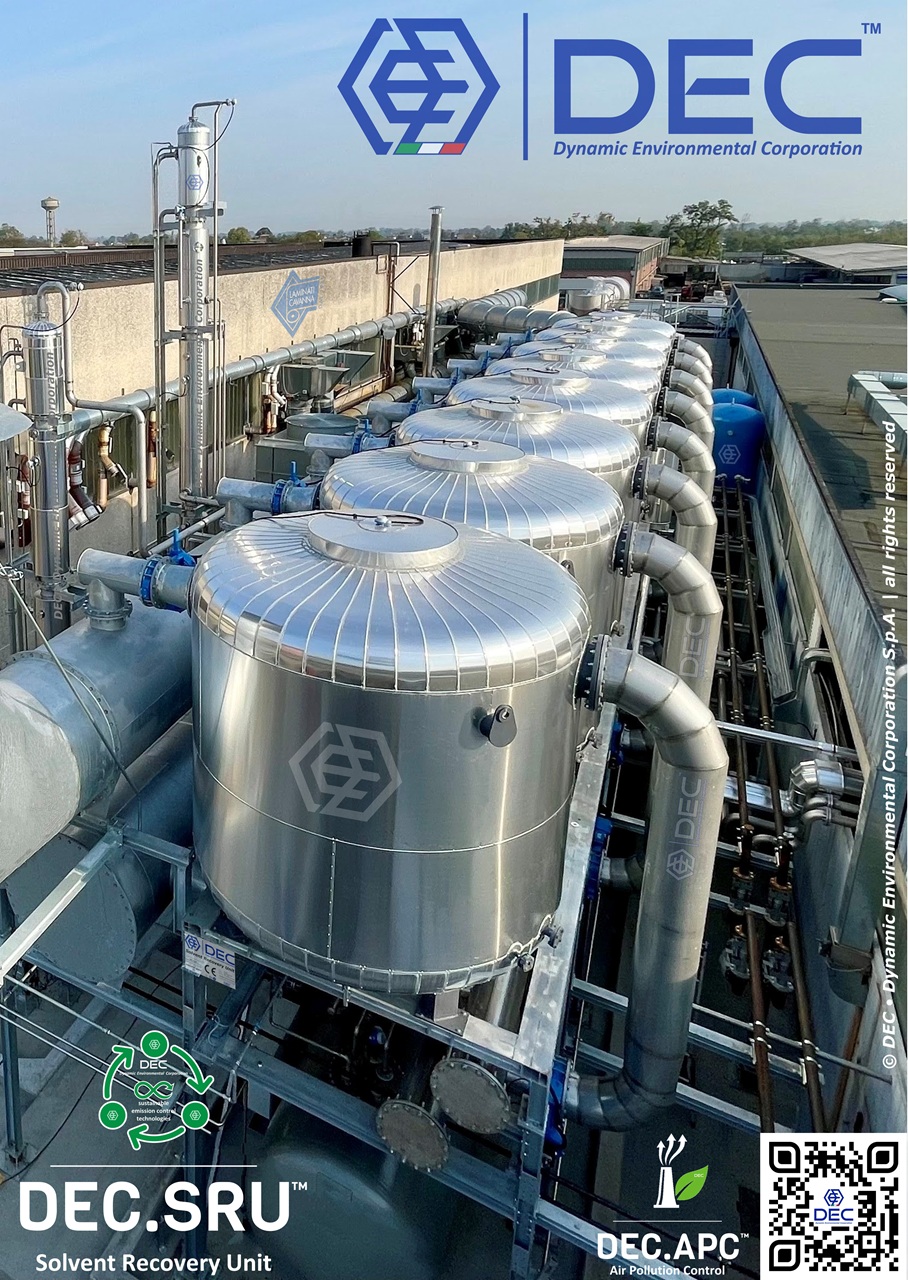
Fans convey solvent-laden air (SLA) through activated-carbon adsorbers. The carbon captures VOCs while treated air exits the adsorption stage. When an adsorber reaches its operating limit, the automated cycle isolates and regenerates the bed under controlled conditions. Read more about the principles of adsorption and desorption.
For suitable solvent mixtures, DEC.SRU_RSG™ nitrogen regeneration releases the adsorbed solvent while maintaining an inert regeneration environment. The solvent-bearing regeneration gas is cooled and condensed. DEC.ADM_PHD™ gas-phase dehydration reduces residual water where required, and DEC.DST™ distillation can further condition or separate recovered solvent when the process specification calls for it. The selected configuration depends on solvent composition, water content and the required quality for reuse. For ethyl acetate and related acetate mixtures, see the ethyl acetate solvent-recovery case study.
DEC.SRU-Lam™ integration can also incorporate DEC.ULP™ Ultra-Loop™ energy recovery to reduce energy demand where the process conditions and plant configuration allow. Equipment selection, heat integration and operating strategy are defined for the specific lamination line and its production profile. Additional options are described in DEC's energy-recovery solutions.
Benefits for laminators and flexible packaging converters
- Solvent reuse: recovers solvent for reuse when it meets the agreed process specification, reducing dependence on fresh solvent purchases.
- VOC emission control: captures solvent from collected drying exhaust and supports compliance with applicable VOC emission regulations.
- Production integration: treats exhaust without changing the adhesive application and web-bonding steps when correctly designed and integrated.
- Process-specific engineering: accounts for exhaust variability, solvent composition, humidity, operating schedules and the required recovered-solvent quality.
- Resource and energy efficiency: combines solvent recovery, dehydration, optional distillation and energy recovery where technically suitable.
Engineering inputs for every lamination configuration
To assess solvent recovery for solvent-based lamination, DEC needs the same core engineering information regardless of whether the line is duplex, triplex, retort or another multilayer configuration:
- Exhaust airflow, temperature, humidity and solvent composition, including ETAC concentration and solvent mass loading.
- Production schedule, operating hours, line speed, adhesive application rate and expected variability during product changes.
- Drying-zone exhaust capture, duct layout, fan control and any opportunity to combine compatible exhaust streams safely.
- Adhesive and substrate details, intended operating conditions, and the required specification and destination for recovered solvent.
- Relevant site constraints, available utilities, existing VOC-control equipment and opportunities for energy integration.
For extrusion lamination, the molten-polymer bonding step is typically solventless. The assessment therefore focuses on any separate solvent-based printing, coating, adhesive application or drying exhaust connected with the line.
Solventless lamination: keep exhaust streams separate
Do not route exhaust from solventless laminating processes to a DEC.SRU-Lam™ solvent-recovery system. Solvent-recovery adsorbers are designed to treat solvent-bearing exhaust. Sending unsuitable solventless-process emissions into the activated-carbon beds can introduce contaminants that foul or clog the carbon.
Carbon fouling increases pressure drop across the adsorbers and can reduce solvent adsorption capacity, recovery efficiency and overall system performance. Keep solventless-process exhaust separate from solvent-bearing drying exhaust, and assess each stream independently before connecting it to the solvent-recovery plant.
Where solventless lamination and solvent-based operations share a production line, the exhaust system shall include a dedicated bypass to route the solventless-process exhaust directly to atmosphere without passing through the solvent-recovery adsorbers. The bypass arrangement and atmospheric discharge shall comply with applicable permits, emission limits and site safety requirements. Only compatible solvent-bearing exhaust streams shall be routed to the DEC.SRU-Lam™ system, subject to process assessment.
Recovered-solvent quality
DEC.SRU-Lam™ configurations can combine adsorption and regeneration with DEC.ADM_PHD™ dehydration and DEC.DST™ distillation where required. The treatment train is selected to achieve the agreed solvent quality, including water content and purity, for the intended reuse. Final performance depends on the incoming solvent mixture, impurities, design basis and operating conditions.
Modular systems and plant integration
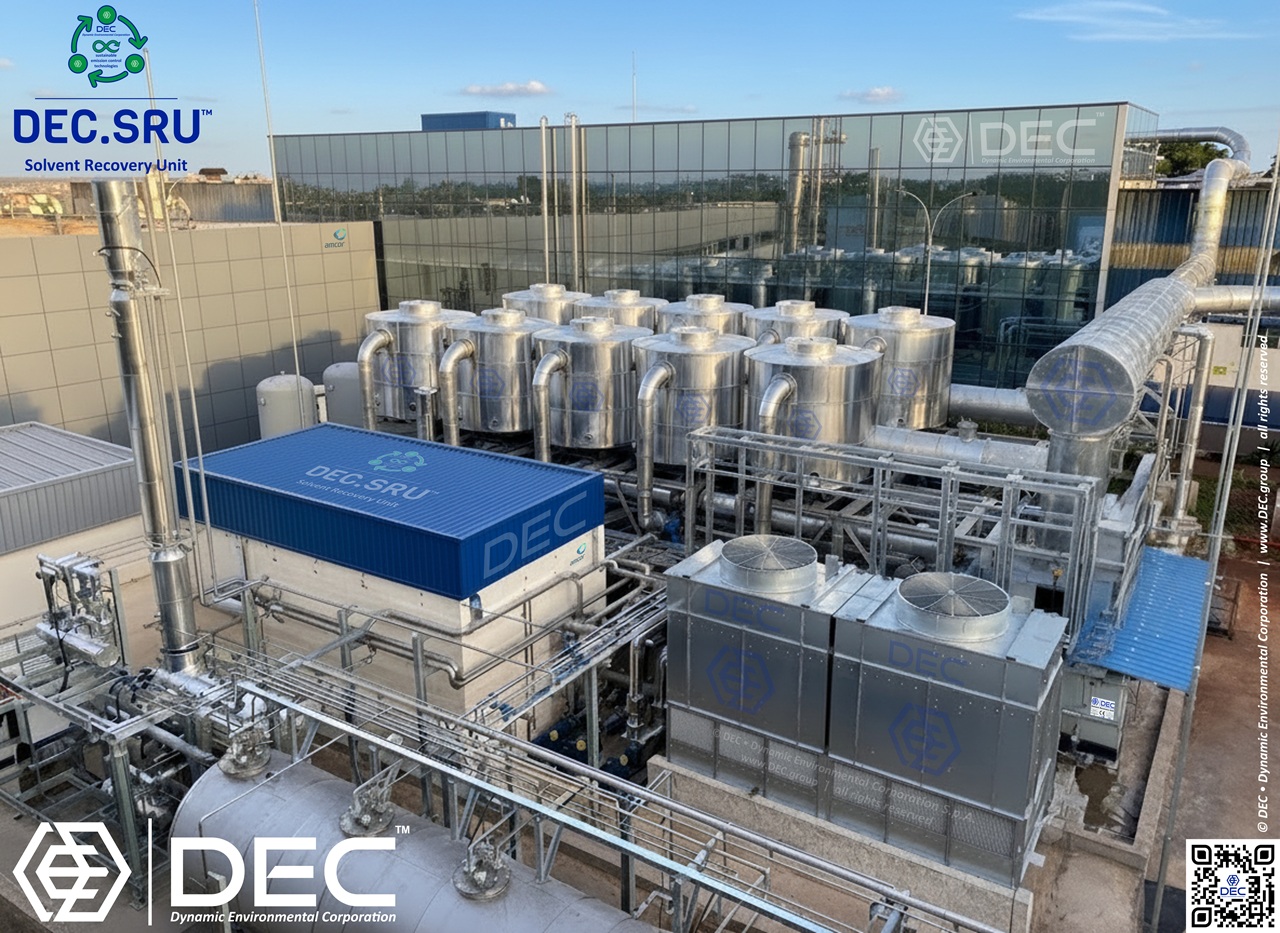
DEC.SRU-Lam™ systems are engineered for the process capacity, site layout and operating profile of each converter. Modular configurations can support compact installations, while custom-built systems accommodate project-specific requirements. Integration is planned to limit interference with upstream production and to provide maintainable access for operation and service.
Related solvent-recovery resources
- DEC.SRU_SMS™ Smart Modular Systems for modular plant configurations.
- DEC.SRU_CBS™ Custom Built Systems for project-specific installations.
- Activated-carbon performance and its role in adsorption systems.
- VOC emission control for flexible packaging.
Contact DEC
Use the solvent-recovery engineering guide to understand the main design inputs. For lamination-specific VOC control context, see VOC emission control for lamination industries. Contact DEC to assess solvent recovery for your laminating line, flexible film lamination process or laminating of plastic films. DEC will review the exhaust data, solvent mix, production profile and reuse requirements to define a suitable DEC.SRU-Lam™ configuration.