
Solvent Recovery for Flexo Printing
DEC.SRU-Flexo™ ♻️ Activated Carbon Solvent Recovery | SRU | SRS | SRP
Vapor-phase VOC recovery for flexographic printing, flexible packaging and converting — designed to capture solvent-laden air, recover reusable solvents and reduce the environmental and operating cost of solvent consumption.
- Process
- Activated-carbon adsorption of solvent-laden air followed by TSA regeneration and condensation/recovery.
- Typical VOCs
- Ethyl acetate, ethanol, n-propanol, isopropanol and other solvent mixtures used in solvent-based inks, coatings and adhesives.
- Regeneration
- DEC.RSG™ dry-nitrogen TSA — a steamless regeneration process matched to alcohol-rich flexographic VOC mixtures.
- Recovery objective
- Recover solvent as a reusable liquid rather than destroy it by oxidation; final purity depends on solvent mixture and downstream purification requirements.
- Energy strategy
- DEC.THR™ and DEC.ULP™ recover thermal energy from the SRU cycle; dehydration and cooling optimization can further reduce utility demand.
- Plant formats
- DEC.SRU-SMS™ modular skid systems or DEC.SRU-CBS™ custom-built systems, with retrofit and modernization pathways for existing plants.
Why solvent recovery · How activated carbon recovery works · Solvent selection & mixtures · Regeneration options · Dehydration & purity · Energy recovery · Safety & controls · Integration & modernization · FAQs
Why solvent recovery matters in flexographic printing
Flexographic printing and converting can generate substantial VOC emissions as solvent-based inks, coatings and adhesives dry. The critical engineering task is not simply to destroy the VOCs, but to determine whether the solvent has sufficient value, recoverability and process stability to justify recovery.
A DEC.SRU™ Solvent Recovery Unit captures solvent vapors from the process exhaust and converts them back into a reusable liquid stream. This changes the treatment objective from “destroy the emission” to “recover the solvent and control the residual emission”.
For a converter, the economic case combines avoided fresh-solvent purchases, lower waste handling, reduced VOC emissions and the value of maintaining a circular solvent loop. The environmental case can extend beyond stack emissions because recovering solvent avoids the need to manufacture, transport and subsequently destroy an equivalent quantity of fresh solvent.
The suitability of recovery is application-specific. Solvent composition, water content, airflow, concentration, operating hours, required recovered-solvent quality, fire and explosion protection, available utilities and local emission limits should all be evaluated before selecting the process architecture.
Where activated-carbon solvent recovery fits
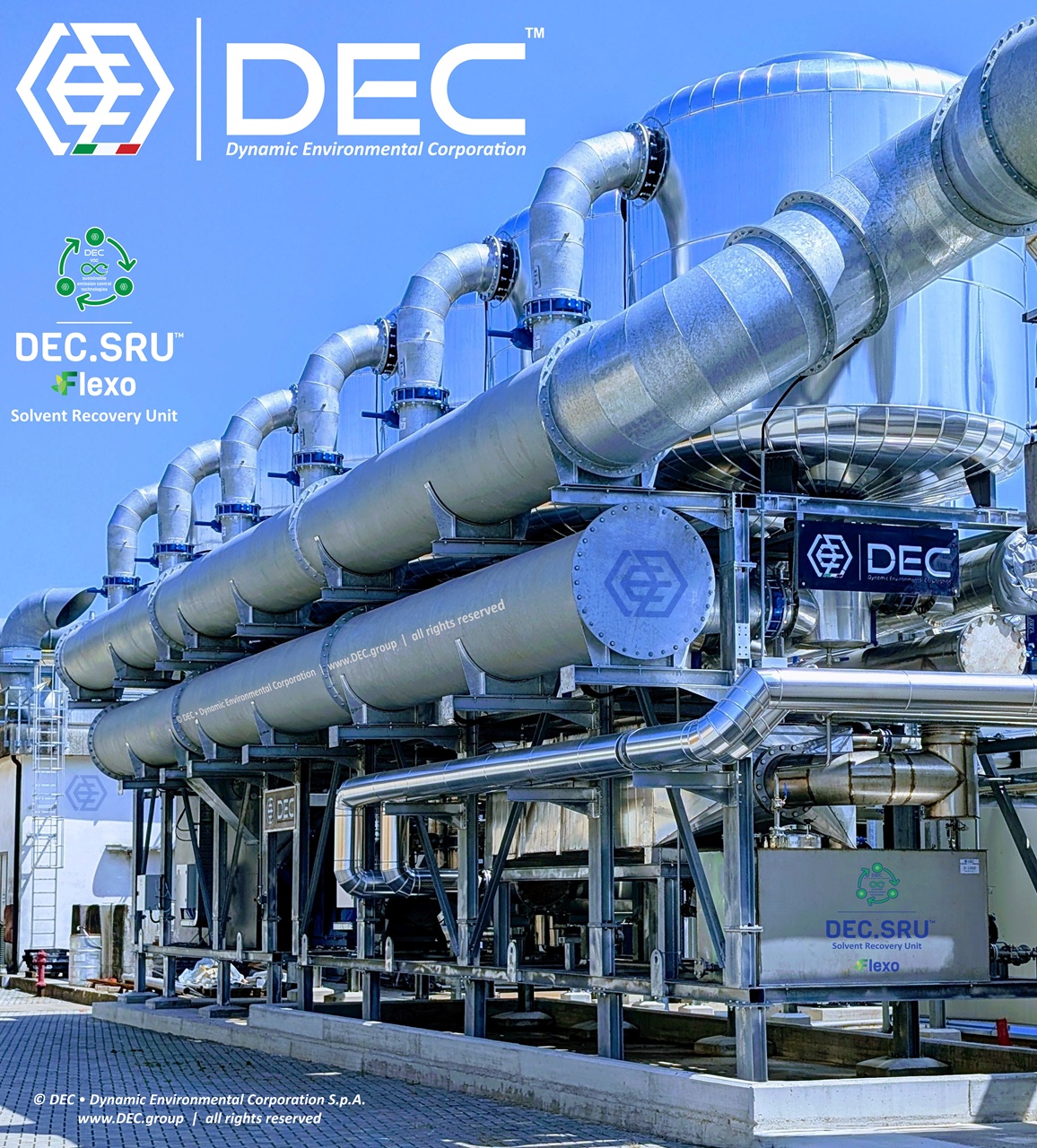
DEC.SRU-Flexo™ is intended for solvent-bearing process exhaust from flexographic printing and related converting operations. Typical sources include press dryers, solvent-based ink application, coating, laminating and associated solvent-handling exhaust systems.
Flexographic VOC streams are typically multi-solvent mixtures, often containing substantial fractions of alcohols and esters such as ethanol, n-propanol, isopropanol, ethyl acetate and n-propyl acetate. The actual adsorption and regeneration design is established from the complete solvent composition, water content, airflow, concentration range and operating envelope.
For these solvent mixtures, DEC.RSG™ dry-nitrogen TSA is the dedicated recovery architecture for DEC.SRU-Flexo™. The steamless regeneration cycle avoids introducing additional water into an alcohol-rich solvent-recovery loop and supports controlled desorption followed by condensation of the concentrated regeneration stream.
How activated-carbon solvent recovery works
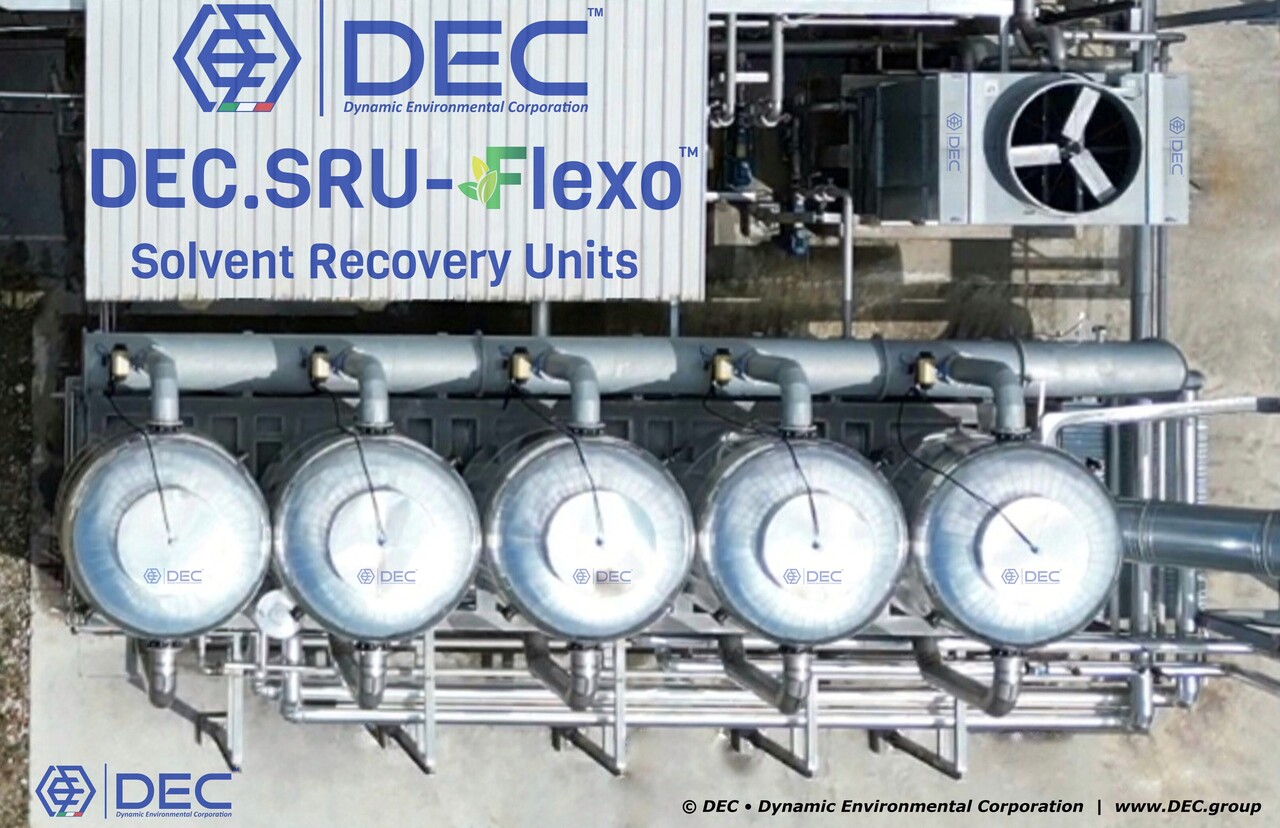
The process begins with Solvent-Laden Air (SLA), which is conveyed from the flexographic process to a multi-adsorber system. Activated carbon provides a high internal surface area on which VOC molecules are physically adsorbed while the treated air leaves the adsorption vessel.
When an adsorber approaches its designed loading or breakthrough condition, the process switches to another available adsorber so VOC capture remains continuous. The loaded bed then enters regeneration, releasing the adsorbed solvent into a much smaller, concentrated regeneration stream.
DEC.RSG™ uses dry nitrogen as the regeneration medium. For flexographic solvent recovery, this dry, steamless TSA architecture is the natural match for the chemistry of solvent-based inks, which commonly contain substantial fractions of alcohols together with esters and other VOCs. Keeping the regeneration circuit dry avoids introducing steam into a recovery process where water would complicate condensation, solvent separation and recovered-product quality.
DEC.RSV™, DEC.RTV™ and DEC.RSC™ are not presented as flexographic solvent-recovery processes. Steam regeneration, vacuum-assisted regeneration and direct condensation address different process envelopes and are not the appropriate basis for the DEC.SRU-Flexo™ process architecture.
The concentrated regeneration stream is cooled and condensed. Depending on solvent chemistry, the recovered liquid may be ready for reuse, may require gas-phase or liquid-phase dehydration, or may require additional purification or separation. The correct endpoint is defined by the customer’s solvent-reuse specification rather than by a generic “one-size-fits-all” recovery target.
Multi-solvent recovery: chemistry matters
Flexographic solvent systems are frequently mixtures rather than single components. Alcohols and esters can behave differently during adsorption, desorption, condensation and water separation. Consequently, the recovered stream composition is influenced not only by the original ink formulation but also by relative evaporation rates, adsorption affinity, water content and the operating history of the carbon.
A solvent-recovery project should therefore establish a representative solvent mass balance: annual solvent consumption, solvent fractions, peak and average SLA concentration, airflow, humidity, operating hours and the desired quality of the recovered solvent. Changes in ink formulation or diluent practice should be considered part of the design envelope.
For variable solvent recipes, process monitoring and adaptive regeneration can be more valuable than designing around one nominal composition. The objective is to maintain stable adsorption capacity and recovered-product quality as production conditions change.
Why DEC.RSG™ dry nitrogen TSA matches flexographic solvent chemistry
For flexographic solvent recovery, regeneration is not a generic utility choice. It is dictated by the chemistry of the ink-derived VOC mixture. Alcohols are a significant component of many solvent-based flexographic formulations, and the recovery process therefore benefits from a dry, steamless TSA cycle.
DEC.RSG™ uses dry nitrogen to thermally regenerate the activated carbon. The process preserves a dry regeneration environment, releases the adsorbed solvent into a concentrated gas stream and sends that stream to the recovery section. This architecture is particularly well aligned with flexographic mixtures containing alcohols because it avoids adding steam-derived water to the solvent recovery loop.
The objective is not simply to regenerate carbon, but to regenerate it under conditions that support stable adsorption, controlled desorption, efficient condensation and a recovered solvent stream suitable for the intended reuse specification. The regeneration temperature profile, nitrogen circulation, bed sequencing and condensation duty are therefore designed together around the actual solvent mass balance.
DEC.RSV™, DEC.RTV™ and DEC.RSC™ are not suitable process choices for DEC.SRU-Flexo™. They are different process architectures for different solvent and operating envelopes. Flexographic solvent recovery is specifically based on DEC.RSG™ dry-nitrogen TSA.
For existing flexographic installations, this distinction is important when evaluating modernization. A steam-based or other legacy configuration should not be assumed to be convertible to RSG by changing controls alone; the regeneration circuit, vessels, valves, piping, heat-transfer equipment, condensation section, instrumentation and safety logic must be evaluated as an integrated process.
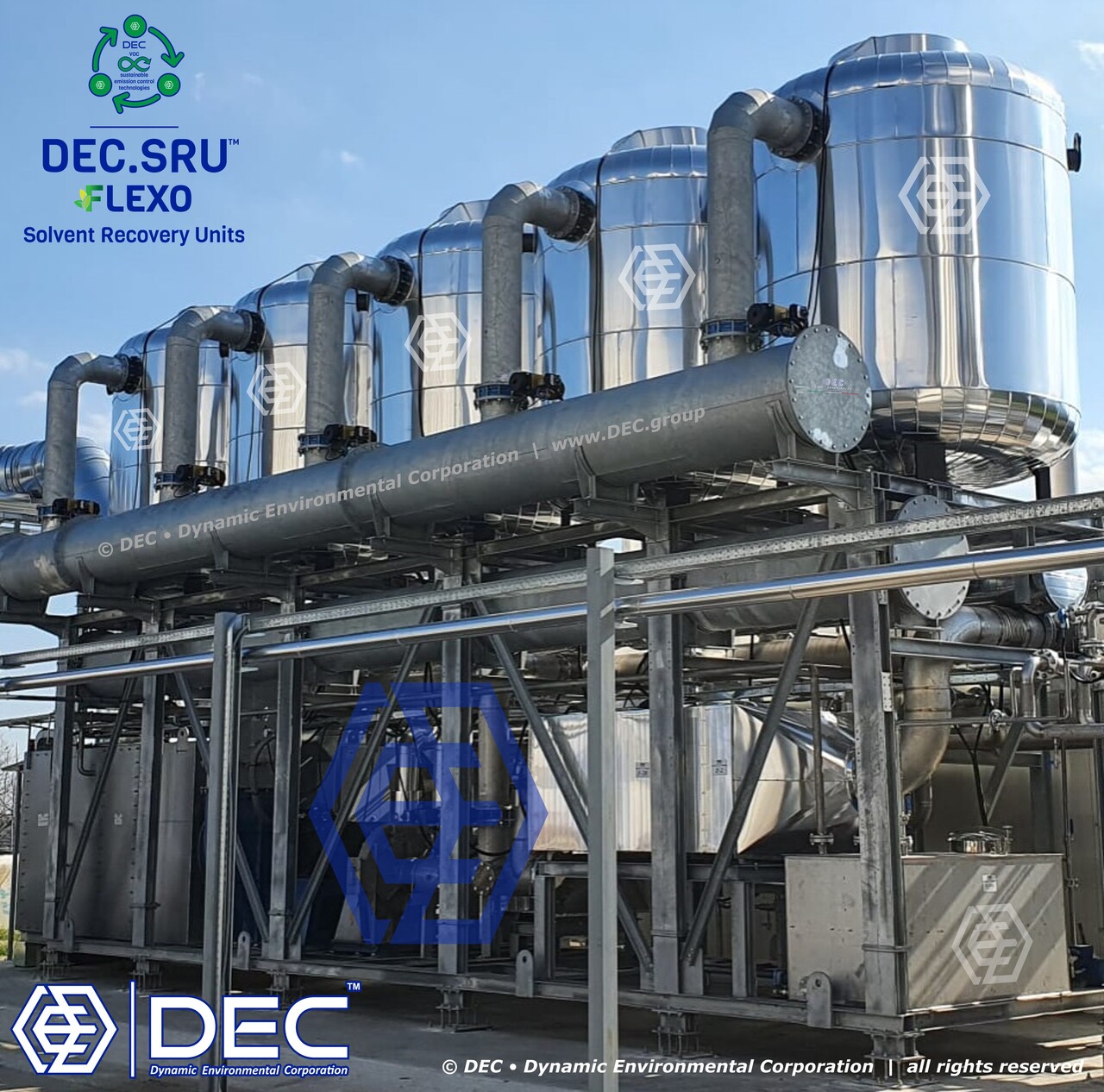
Dehydration, condensation and recovered-solvent quality
Water management can strongly influence the energy balance and recovered-solvent quality of multi-solvent flexo SRUs. DEC uses DEC.ADM™ Advanced Dehydration Modules to address dehydration as an engineered process function rather than an afterthought.
Depending on the process, first-stage gas-phase dehydration can use DEC.ADM_PHD™ or DEC.ADM_FDP™. A second-stage dehydration step can use DEC.ADM_UDS™ or molecular-sieve technology where the required solvent specification justifies it.
After RSG regeneration, the solvent-rich gas is cooled through an engineered condensation train. Direct condensation alone is not the recovery mechanism for typical flexographic solvent-laden air: the VOC concentration in the captured process exhaust is generally too low for direct condensation to provide an efficient primary recovery route. Activated-carbon adsorption is therefore essential because it first concentrates the solvent into a much smaller regeneration stream; condensation then performs the recovery from that concentrated stream.
The engineering objective is to minimize unnecessary water load, avoid excessive refrigeration demand, protect recovered-solvent quality and ensure that any aqueous phase or residual solvent stream has a defined treatment or reuse route.
Energy recovery, energy saving and decarbonization
Modern solvent recovery systems can reduce utility demand by reusing heat already present in the regeneration cycle. DEC.THR™ Thermal Heat Recovery and DEC.ULP™ Ultra-Loop™ are engineered around this principle: recover useful thermal energy from one part of the SRU cycle and return it to another part of the process.
Energy optimization can involve more than one heat exchanger. It can include regeneration-cycle timing, thermal storage, condensation temperature, cooling-system selection, dehydration strategy, pressure drop, fan power and the way multiple heat-recovery loops are integrated. In a properly engineered SRU, these variables are treated as one heat-and-mass balance.
For existing plants, SRU revamping and retrofit engineering can identify opportunities to recover waste heat, reduce natural-gas or electrical demand where applicable, improve cooling efficiency, modernize controls and extend equipment life.
Key takeaway
The strongest energy-saving strategy is usually a system-level optimization: stable capture + optimized regeneration + dehydration + condensation + thermal recovery + controls, rather than a single heat exchanger added in isolation.
Plant integration, RBC concentration and future expansion
Where airflow is very large and VOC concentration is low, a DEC.RBC™ VOC Rotor Concentrator can be evaluated upstream of the SRU to concentrate VOCs and reduce the gas volume presented to the recovery stage. The same upstream concept can also support fugitive and diffuse VOC emission reduction: fugitive sources must first be effectively enclosed, captured or extracted into a controlled air stream, after which the RBC can concentrate the collected VOC load for downstream treatment or recovery. This can be especially relevant where several printing lines, ancillary solvent-handling areas or diffuse sources share a treatment system or where production expansion creates a large airflow envelope.
The broader DEC.HSU™ Hybrid Sorption Unit architecture allows the concentration stage to be positioned according to the emission-control objective. For flexographic solvent recovery, the upstream RBC concept is specifically evaluated as a front-end concentration and fugitive-emission collection strategy feeding DEC.SRU™ RSG™. Source capture and airflow management remain essential: an RBC cannot treat fugitive emissions that are not effectively collected.
The benefit of this approach is scalability: the capture and concentration section can be developed around the production airflow while the solvent-recovery section is sized around the concentrated solvent load. This can help avoid oversizing the entire recovery plant around transient or dilute airflow conditions.
Modularity, retrofit and modernization of existing flexo SRUs
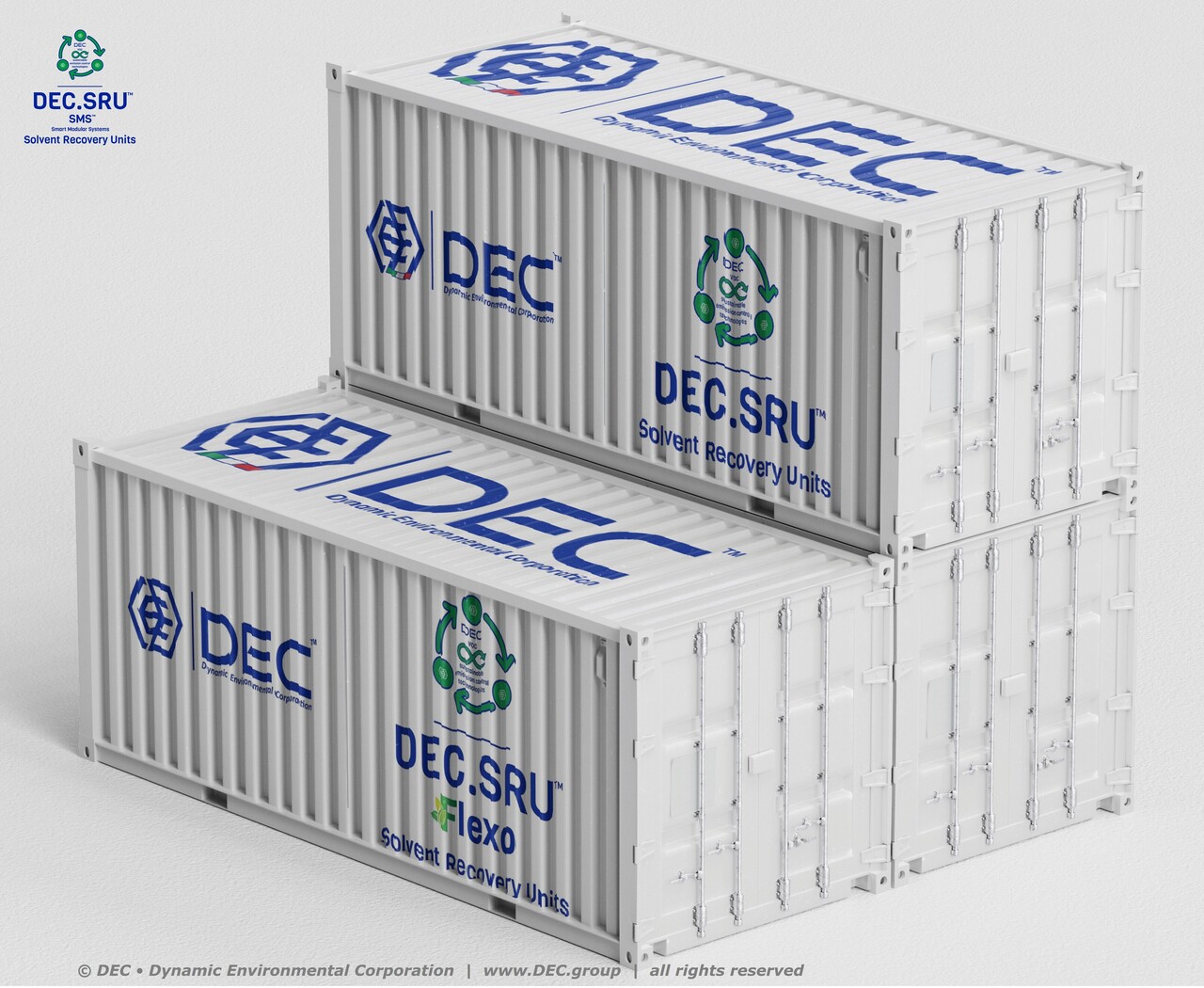
DEC.SRU-Flexo™ is available on the DEC.SRU-SMS™ Smart Modular System platform or as a DEC.SRU-CBS™ Custom Built System.
For an existing installation, the first question is not “replace or keep?” but “what remains technically reusable?”. Vessels, carbon beds, valves, condensers, fans, chillers, piping, instruments, PLC architecture and structural elements can have very different remaining useful lives.
A refurbishment restores usable equipment; a retrofit adds new technology while retaining suitable existing assets; a rebuild reconstructs major subsystems; replacement is reserved for cases where vessel architecture, capacity, materials, pressure-temperature limits or future operating requirements cannot support the target envelope.
A modern revamping program can therefore combine activated-carbon replacement or reactivation, sealing and valve renewal, upgraded instrumentation, improved VOC monitoring, revised regeneration control, energy recovery, dehydration, condenser or BCS improvements and electrical/control modernization without automatically discarding the complete plant.
Safety, capture and process control
VOC recovery begins with effective capture. The SRU cannot treat emissions that bypass the collection system, so press-dryer enclosure, duct design, airflow balancing and stable operating conditions are fundamental parts of the environmental-control system.
Activated carbon and solvent vapors also require process-safety engineering. The final design should address solvent flammability, oxygen concentration, LEL management, temperature monitoring, hot-spot detection, fire protection, static control, hazardous-area classification and safe shutdown/restart procedures in accordance with the applicable site and jurisdictional requirements.
Continuous or appropriately located VOC measurement can support bed-switching and regeneration logic. Instrumentation should be selected around the actual process risk and performance requirement rather than added only after commissioning.
Technology maturity and sector experience
DEC.SRU-Flexo™ has been developed specifically around the operating requirements of flexographic printing and converting, with a technology lineage extending across multiple generations. The current platform combines activated-carbon adsorption, automated regeneration, solvent dehydration and condensation with modular plant engineering.
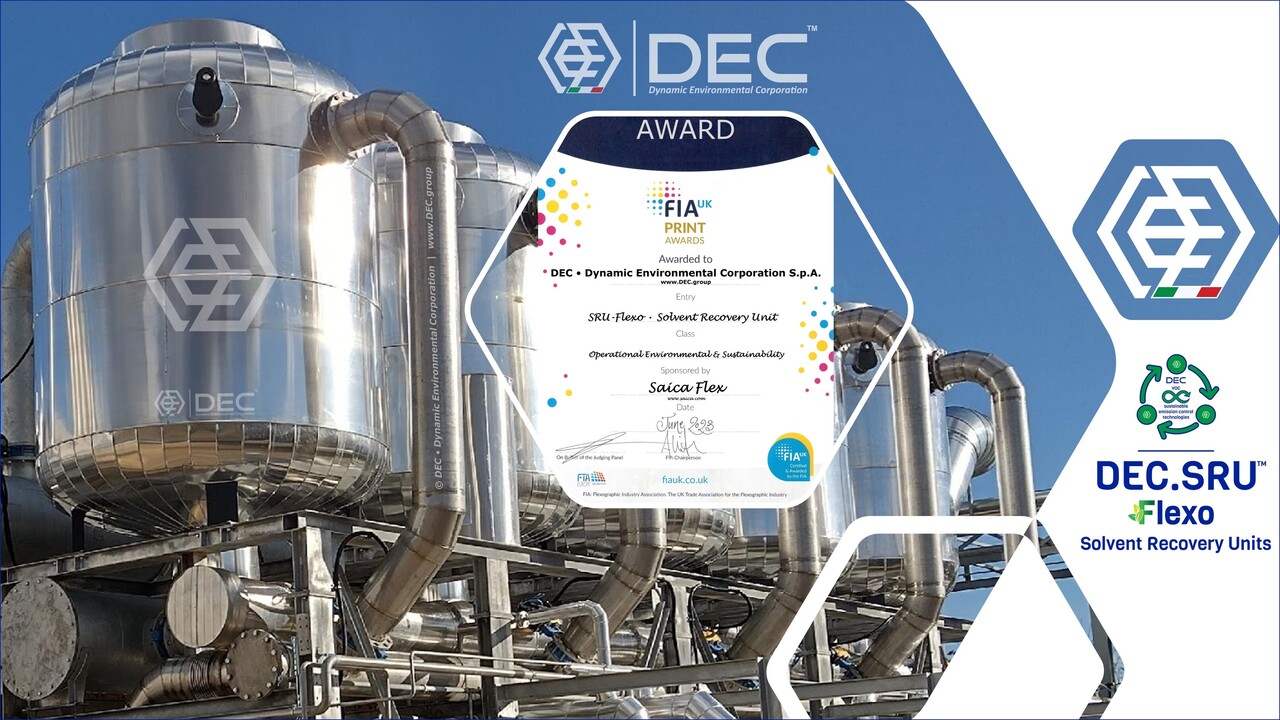
The technology has also received external industry recognition for operational environmental and sustainability performance.
FAQs • Frequently Asked Questions
What is solvent recovery for flexographic printing?
It is the capture of solvent vapors from flexographic process exhaust, typically using activated-carbon adsorption, followed by regeneration, condensation and recovery of the solvent as a reusable liquid. It is a recovery technology rather than a destructive oxidation process.
Which solvents can be recovered from flexo exhaust air?
Typical flexo solvent mixtures include ethyl acetate, ethanol, n-propanol, isopropanol and other esters, alcohols and glycol-ether-type solvents. Actual recoverability and recovered-product quality depend on the complete solvent mixture, water content, concentration and operating conditions.
Why use activated carbon for flexo solvent recovery?
Activated carbon provides high adsorption capacity for many gas-phase VOCs and can continuously capture solvent-laden air while another bed is regenerated. The result is a concentrated regeneration stream that can be condensed and reused.
Why is DEC.RSG™ used for flexographic solvent recovery?
DEC.RSG™ uses dry nitrogen for thermal-swing regeneration of activated carbon. It is the dedicated flexographic recovery architecture because alcohol-rich flexographic VOC mixtures require a dry, steamless regeneration cycle, avoiding the introduction of additional water into the solvent-recovery loop and supporting controlled desorption followed by condensation.
Can a steam-regenerated SRU be converted directly to dry nitrogen regeneration?
Not normally as a simple retrofit. Steam and dry-nitrogen regeneration can require different temperature profiles, piping and utility connections, valves, condensers, controls and safety logic. A conversion should be treated as a plant-specific engineering study and may require substantial rebuilding rather than a controls-only modification.
How does dehydration improve solvent recovery?
Removing water before or during condensation can reduce water load, improve recovered-solvent quality and reduce the energy required for downstream separation. DEC.ADM_PHD™, DEC.ADM_FDP™ and molecular-sieve-based second-stage dehydration can be selected according to the solvent mixture and purity target.
Can an SRU recover multiple solvents at the same time?
Yes, multi-solvent recovery is possible, but the process must be designed around the actual mixture. Different solvents can adsorb and desorb differently and may form water-rich or azeotropic mixtures, so mass balance, condensation behavior and the required reuse specification must be established during engineering.
Can energy recovery be added to an existing flexo SRU?
Potentially. DEC.THR™ and DEC.ULP™ are designed to recover useful thermal energy from SRU cycles. Retrofit feasibility depends on the existing regeneration architecture, temperature levels, heat balance, space, pressure drop, cooling system and controls.
Can a VOC Rotor Concentrator be integrated with a flexo SRU?
Yes, where the airflow is large and VOC concentration is sufficiently dilute. DEC.RBC™ can be evaluated upstream of DEC.RSG™ to concentrate the collected VOC load before solvent recovery and reduce the gas volume handled by the SRU. The same upstream arrangement can support fugitive and diffuse VOC reduction when those sources are effectively enclosed, captured or extracted into a controlled air stream.
What information is needed to size a flexo solvent recovery system?
The key inputs include SLA airflow and turn-down, VOC concentration range, solvent composition, water content, annual solvent consumption, operating hours, number and type of presses, required emission limit, recovered-solvent quality, available utilities, site constraints and safety requirements.
Can recovered solvent be reused directly in the ink room?
Potentially. Reuse depends on the required solvent specification and the composition of the recovered stream. Some applications may need dehydration, decantation, molecular-sieve treatment or other purification before the recovered solvent is returned to ink formulation or dilution.
Is solvent recovery suitable for smaller flexo plants?
It can be. Modular SRU architectures can be configured around lower solvent loads and expanded as production grows. Economic feasibility should be assessed from annual solvent consumption, solvent value, operating hours, emission requirements and the available site utilities rather than plant size alone.
How does solvent recovery support decarbonization?
Recovering solvent avoids destroying the recovered material by combustion and can reduce the need for virgin-solvent production. Energy recovery, optimized regeneration and electrification of auxiliary equipment can further reduce Scope 1 and Scope 2 emissions, subject to the site electricity mix and overall process balance.
What is the difference between SRU, SRS and SRP?
The terms Solvent Recovery Unit, Solvent Recovery System and Solvent Recovery Plant are commonly used interchangeably for the same broad category of vapor-phase solvent recovery equipment. The exact project scope determines whether the term refers to a single unit, an integrated system or a complete plant.
From flexo VOC emissions to recovered solvent
For a plant-specific assessment, start with the DEC.SRU™ Solvent Recovery Engineering Guide, then evaluate the appropriate regeneration, dehydration, condensation and energy-recovery architecture. DEC can also assess existing plants for SRU revamping, retrofitting and energy recovery.
Contact DEC Technical Sales & Applications for a solvent mass-balance and process-engineering assessment based on your actual flexo production envelope.