
Hybrid Heat Exchanger
DEC.HHX™
The DEC.HHX™ (Hybrid Heat Exchanger) is a specialized process heating system designed to supply high temperature thermal energy for activated carbon regeneration and process fluid heating across industrial Air Pollution Control plants.
Process Heating Solutions for Carbon Regeneration
In Solvent Recovery Units (DEC.SRU™), effective carbon bed desorption requires precise fluid heating. Systems such as DEC.SRU_RSG™, DEC.SRU_RTV™, DEC.ADM_MSU™, and DEC.ADM_UDS™ require heating the carbon bed to target setpoints of 180 to 220 °C, which demands thermal fluid supply temperatures of 240 to 270 °C. Industrial manufacturing sites frequently operate existing utilities, including Thermal Fluid Systems (TFS) delivering hot oil at lower temperatures (150 to 220 °C) or saturated steam. These standard utility loops cannot independently achieve the thermal fluid temperatures of 240 to 270 °C required for process setpoints.
The DEC.HHX™ system bridges this thermal gap. By combining a utility fluid preheating stage with an electric booster stage into a single continuous thermal loop, the DEC.HHX™ allows the Customer to maximize existing plant infrastructure without pushing the existing boiler to a higher operating temperature or having to install a dedicated high temperature boiler. The preheating stage is not limited to a boiler-fed TFS or steam loop — it is also compatible with recovered heat from an on-site cogeneration (CHP) or trigeneration (CCHP) plant, letting sites with existing cogeneration assets reach the required setpoint using otherwise underused recovered heat and generated power.
Technical Operating Configurations
Reaching the required 240 to 270 °C thermal fluid setpoint can be achieved either with the DEC.HHX™ hybrid heat exchanger, or with a stand-alone in-line electric booster, depending on plant hydraulic and thermal loop arrangements.
DEC.HHX™
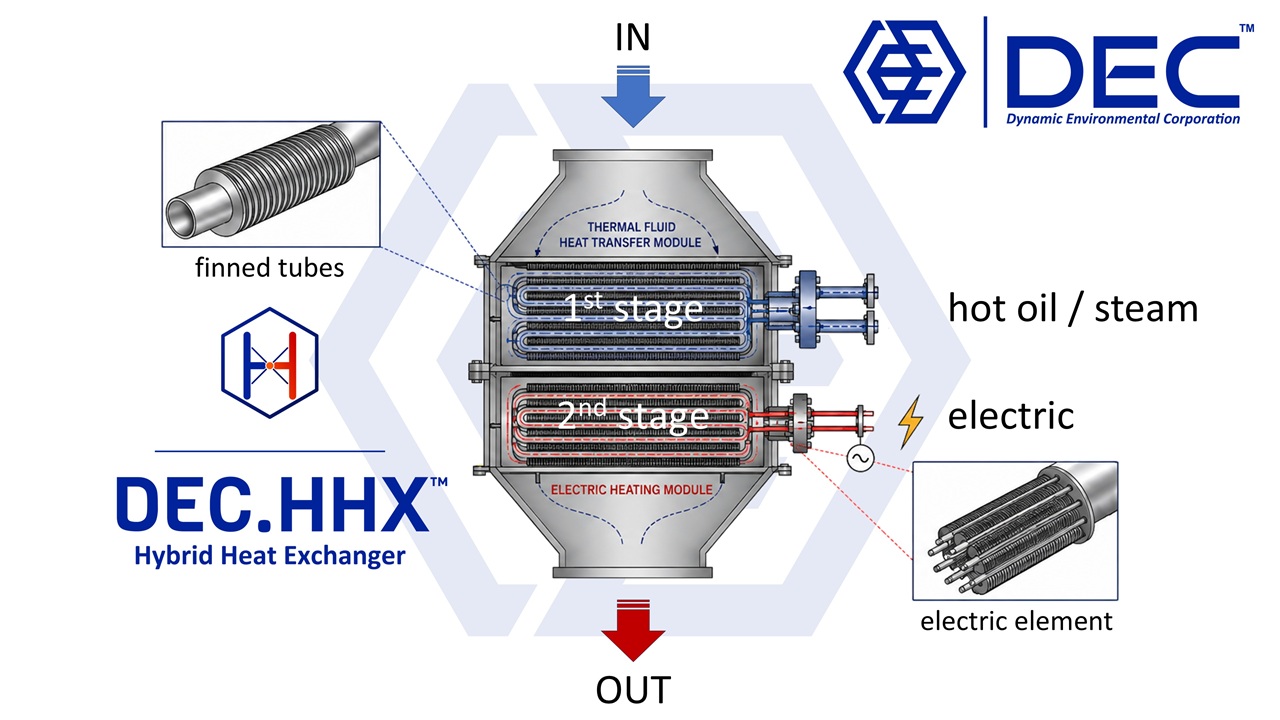
Sequential Two Stage Hybrid Process Heat Exchanger
Sequential Two Stage Hybrid Process Heat Exchanger
- Primary preheating stage: utilizes available lower temperature plant heat sources, including TFS Hot Oil (150 to 220 °C) or saturated steam.
- Electric booster stage: a high efficiency integrated electric process heating exchanger section, positioned downstream of the first-stage heat exchanger, elevates the preheated fluid to the required 240 to 270 °C setpoint.
DEC.IEB™
in-line electric booster
in-line electric booster
- Direct hot oil boosting: an in line electrical heater is installed directly on the hot oil supply line coming from the TFS boiler, elevating the thermal fluid from site supply temperatures (150 to 220 °C) up to the required 240 to 270 °C supply setpoint.
- Process integration: delivers high temperature fluid directly to the regeneration heat exchanger loop without establishing an isolated secondary circuit.
- No SRU reconfiguration: as a stand-alone alternative to DEC.HHX™, the booster is added directly to the existing TFS hot oil supply line, so the SRU plant's overall configuration does not need to change.
Technical exception for distillation systems (DEC.DST™): the DEC.HHX™ two-stage hybrid heat exchanger is not applicable to DEC.DST™ bottom heater reboilers. Depending on process conditions, when site utilities fall below the required thermal setpoint, these reboilers are instead engineered as a 100% full electric reboiler configuration, or fitted with an in-line electric hot oil booster.
Compatibility with Cogeneration (CHP) and Trigeneration (CCHP) Plants
Beyond standard TFS hot oil and saturated steam utilities, the DEC.HHX™ system is fully compatible with sites operating on-site Combined Heat and Power (CHP) cogeneration, or Combined Cooling, Heat and Power (CCHP) trigeneration plants.
- CHP recovered-heat preheating: byproduct thermal energy recovered from a CHP unit's engine, turbine, or generator jacket — delivered as hot water, saturated steam, or thermal oil — can feed the DEC.HHX™ preheating stage in place of, or alongside, a dedicated boiler-fed TFS loop.
- CCHP triple-output compatibility: on sites running trigeneration, the recovered heat stream that would otherwise supply an absorption chiller for process cooling can instead, or simultaneously, be routed to the DEC.HHX™ preheating stage, since CCHP heat, cooling, and power outputs are typically drawn from a common thermal loop.
- On-site power for the electric booster: the DEC.HHX™ electric booster stage can be supplied directly from a CHP/CCHP unit's on-site generated electricity, reducing reliance on grid power to reach the 240 to 270 °C thermal fluid setpoint.
- Asset utilization: plants with cogeneration or trigeneration capacity already installed can extract additional value from otherwise underused recovered heat and generated power, reaching carbon regeneration setpoints without adding fossil-fuel-fired boiler capacity.
- Compatible with both approaches: CHP/CCHP recovered heat integrates into the DEC.HHX™ preheating stage in the same way as TFS hot oil or steam, while CHP/CCHP-generated power can supply either the DEC.HHX™ electric booster stage or a stand-alone in-line electric booster.
Retrofit Integration for Existing SRU Plants
The DEC.HHX™ system is specifically engineered for seamless retrofit integration into existing operating solvent recovery installations (DEC.SRU™, DEC.SRU_RSG™, and DEC.SRU_RTV™).
- Brownfield optimization: allows operating plants to upgrade carbon desorption temperatures without replacing legacy heat exchangers or modifying existing pressure vessels.
- Compact skid architecture: engineered with a minimal footprint, allowing placement into restricted spaces near existing SRU equipment racks.
- Minimal downtime installation: preassembled, factory tested skid modules enable fast mechanical tie ins and rapid electrical integration during scheduled maintenance shutdowns.
- Utility load reallocation: enables operational plants to repurpose excess low temperature site steam or TFS hot oil capacity while adding precise electric trimming.
TFS Boiler Return Temperature and Thermal Balance Considerations
When electing to install a dedicated in-line electrical booster on an existing Hot Oil loop as a stand-alone alternative to DEC.HHX™, specific thermal loop hydraulics and return parameters must be evaluated by the Customer.
- Thermal fluid temperature differential: regeneration heat exchangers operate with a typical temperature differential (ΔT) of 20 °C across the thermal fluid inlet and outlet ports.
- Elevated return fluid thermal profile: with hot oil supplied at 240 to 270 °C to achieve carbon bed desorption, the thermal fluid leaves the regeneration heat exchanger at an elevated return temperature of 220 to 250 °C (reflecting the 20 °C ΔT).
- Impact on central TFS boiler loops: because the returning oil at 220 to 250 °C is significantly hotter than the standard supply oil generated by the TFS boiler (150 to 220 °C), returning this fluid directly to the central TFS header will raise the average return header temperature.
- Potential thermal imbalance on secondary users: returning oil at temperatures higher than the main TFS supply setpoint can disrupt thermal regulation, reduce boiler burner firing ratios, or create energy imbalances on other consumer lines fed from the same central TFS boiler circuit.
- Hydraulic and control mitigation: engineering teams at DEC assist the Customer in integrating primary and secondary loop decoupling, return blending control valves, or dedicated secondary mixing loops to isolate the elevated return oil from the main TFS boiler distribution header.
Project Execution and Manufacturing Lead Time Considerations
Engineering and project management teams must account for specialized supply chain schedules when specifying hybrid or full electric process exchangers.
- Extended equipment lead times: specialized electric immersion heating elements, high alloy pressure vessels, and high power SCR control panels typically require longer manufacturing lead times compared to standard shell and tube utility heat exchangers.
- Critical path management: long lead times for electric and hybrid exchanger modules can impact the overall EPC project schedule if procurement actions are delayed.
- Early engineering freeze: finalizing thermal fluid flow rates, electrical transformer capacity, and control interfaces early in the basic design phase is essential to release long lead electrical hardware and avoid project schedule bottlenecks.
- Procurement coordination: project management teams at DEC work closely with the Customer to align electrical component delivery with site civil and structural readiness.
Key Points of Strength
- Asset optimization: unlocks latent value from existing Customer utility boilers without requiring major civil or boiler utility additions.
- Retrofit compatibility: upgrades existing operating SRU systems with minimal structural changes and short tie in outage windows.
- Flexible integration: standard skid design adapts easily to site utility constraints across multiple DEC plant configurations.
- Carbon desorption performance: guarantees precise 240 to 270 °C thermal fluid supply to maintain peak carbon regeneration efficiency.
- Modularity: factory preassembled skids reduce on site mechanical and electrical installation time.
- Process adaptability: dynamically balances utility heat input with electric power based on real time site utility supply fluctuations.
- CHP/CCHP synergy: captures otherwise underused cogeneration or trigeneration recovered heat and on-site generated power to reach carbon regeneration setpoints.
Comprehensive Advantages and Disadvantages Analysis
Deploying a hybrid heat exchanger involves specific capital, operational, electrical balance, and project schedule parameters.
| Performance Vector | Advantages of DEC.HHX™ Hybrid Configuration | Disadvantages and Operational Considerations |
|---|---|---|
| Capital Expenditure (CAPEX) | avoids major capital outlay required for a new high temperature TFS boiler system; reduces civil and permitting expenses. | higher exchanger equipment CAPEX compared to a single heat exchanger due to dual section fabrication, booster vessels, and SCR electrical panels. |
| Manufacturing and Project Lead Time | avoids lengthy permitting and installation schedules associated with new site boilers. | electric and hybrid exchangers face longer manufacturing lead times for SCR panels and specialized heating elements, requiring early procurement to prevent project schedule delays. |
| Retrofit Capability | easy plug and play integration on existing SRU plants; extends the operational life and efficiency of installed assets. | requires evaluation of available space in existing plant layouts and routing for heavy electrical feed cables. |
| Operational Expenditure (OPEX) | minimizes electricity costs by utilizing low cost site utilities for the primary thermal load; electric power is consumed only for booster elevation. | ongoing electric utility costs for running the booster stage; total OPEX depends on local power tariffs. |
| Site Infrastructure | fits within existing boiler house utility capacities; avoids expanding fossil fuel gas or oil supply lines. | requires adequate site electrical transformer capacity and heavy cabling to supply the electric booster skid. |
| Process Control and Flexibility | rapid SCR electric element control ensures tight setpoint accuracy regardless of utility steam or oil pressure fluctuations. | increased complexity in instrumentation and dual loop control logic compared to single energy source systems. |
| TFS Boiler Loop Balance | provides maximum utility heat recovery when configured as a decoupled two stage system. | in line hot oil boosting results in 220 to 250 °C return temperatures (based on a 20 °C ΔT), which can cause thermal imbalances on central TFS boiler loops if not decoupled. |
| Boiler Permitting and Emissions | zero additional direct site emissions; avoids complex air permitting modifications associated with new site boilers. | increased dependence on grid electricity stability for peak heating demand phases. |
Thermal Power Calculations
Detailed thermal power sizing calculations — mass flow rate, Mobiltherm 605 fluid properties, heat duty (Q̇), and electrical power input at 98% conversion efficiency — are provided in the dedicated reference page for the DEC.IEB™ • in-line electric booster for Heat Thermal Fluids (HTF), since this single-stage electric heating calculation applies to that stand-alone alternative rather than to the DEC.HHX™ two-stage hybrid exchanger architecture.
Technical Specifications Overview
- Thermal fluid supply temperature:
- 240 °C to 270 °C continuous output.
- Thermal fluid return temperature:
- 220 °C to 250 °C (based on process ΔT of 20 °C).
- Process bed target temperature:
- 180 °C to 220 °C carbon regeneration setpoint - compatible with DEC.DTD™ (Deep Thermal Desorption) process.
- Primary utility media compatibility:
- Thermal Fluid System (TFS) Hot Oil (150 to 220 °C), Saturated Steam, High Pressure Hot Water, Cogeneration (CHP) / Trigeneration (CCHP) recovered heat.
- Booster heating technology:
- direct immersion electric element bundle with high grade alloy sheath material.
- Temperature control system:
- closed loop PID control with SCR power controller for rapid load adjustment.
- System integration:
- preengineered skid mounted assembly fully compatible with DEC solvent recovery and air treatment systems (both new builds and retrofits).
- Code compliance:
- built to global industrial standards including ASME, PED, and regional pressure vessel requirements.
Ready to Start Your Project?
Contact Us
FAQs • Frequently Asked Questions
Hybrid Heat Exchanger • DEC.HHX™
What is the DEC.HHX™ Hybrid Heat Exchanger and what does it do?
DEC.HHX™ (Hybrid Heat Exchanger) is a specialized process heating system that supplies high temperature thermal energy for activated carbon regeneration and process fluid heating across industrial Air Pollution Control plants, by combining a utility fluid preheating stage with an electric booster stage into a single continuous thermal loop.
What temperatures does DEC.HHX™ deliver, and why can't standard plant utilities reach them alone?
DEC.HHX™ boosts thermal energy needed to heat carbon beds to their 180–220°C regeneration setpoint. Standard site utilities such as Thermal Fluid System (TFS) hot oil (150–220°C) or saturated steam cannot reach the 240 to 270°C thermal fluid supply this requires on their own, so DEC.HHX™ bridges the gap with an electric booster stage.
What is the difference between DEC.HHX™ and an in-line electric booster?
DEC.HHX™ is a sequential two-stage hybrid heat exchanger, preheating fluid with existing plant utilities before an integrated electric booster stage raises it to setpoint. As a stand-alone alternative, an in-line electric booster can instead be installed directly on the existing TFS hot oil supply line to elevate it to the required 240–270°C without a separate secondary circuit — and without changing the SRU plant's overall configuration.
Can DEC.HHX™ be retrofitted onto an existing DEC.SRU™ plant?
Yes. DEC.HHX™ is specifically engineered for retrofit into existing DEC.SRU™, DEC.SRU_RSG™ and DEC.SRU_RTV™ solvent recovery installations, using a compact, factory-tested skid that ties in with minimal downtime and without replacing legacy heat exchangers or pressure vessels.
Is DEC.HHX™ compatible with cogeneration (CHP) or trigeneration (CCHP) plants?
Yes. DEC.HHX™ can use recovered heat from an on-site CHP or CCHP unit — delivered as hot water, saturated steam, or thermal oil — to feed its preheating stage in place of, or alongside, a dedicated TFS boiler loop, and its electric booster stage can be supplied directly from the CHP/CCHP unit's on-site generated electricity, letting cogeneration and trigeneration sites reach the 240–270°C setpoint without adding fossil-fuel-fired boiler capacity.
Is pricing available for DEC.HHX™, and can I purchase a system directly?
DEC.HHX™ is a custom-engineered, quote-based process heating system rather than an off-the-shelf product, so there is no fixed list price. Each system is sized, specified and priced by DEC's engineering team after evaluating your plant's thermal loop, utility availability and process requirements — request a project quote via the contact page.