Gravity Decanter Separator
DEC.ADM_GDS™
DEC.ADM_GDS™ (Gravity Decanter Separator) is an industrial gravity decanter designed for the continuous separation of immiscible liquid phases based on density difference. It provides reliable phase separation without mechanical internals, making it suitable for demanding industrial processes where robust, low-maintenance operation is required.
DEC.ADM_GDS™ can separate liquid-liquid, liquid-solid, or combined liquid-liquid-solid phases, depending on the process configuration and feed characteristics. Controlled residence time, flow distribution and settling conditions promote efficient separation while minimizing entrainment and carryover between phases.
Typical applications include solvent recovery, wastewater treatment, chemical processing, petrochemical operations, oil-water separation, condensate handling and process-liquid purification.
DEC.ADM_GDS™ • industrial gravity phase separation
Gravity decanting separates phases by exploiting differences in density under controlled settling conditions. DEC.ADM_GDS™ is engineered as a continuous industrial separation step where the feed, residence time, flow distribution, phase interface and outlet configuration are matched to the required duty.
The design is intentionally simple: the separation mechanism is gravity-based rather than mechanically driven. This supports dependable operation with no rotating or moving internal components and can reduce operating and maintenance requirements compared with mechanically driven separation equipment.
What DEC.ADM_GDS™ can separate
Liquid-liquid separation
For immiscible liquids with a suitable density difference, the decanter promotes phase settling and controlled withdrawal of the separated liquid phases. Applications can include oil-water separation, condensate handling and solvent-containing process liquids.
Liquid-solid separation
Where suspended or settled solids are present, the decanter can be configured to promote gravity settling and controlled removal of the solid-rich phase, subject to feed characteristics and the required separation efficiency.
Liquid-liquid-solid separation
For feeds containing two immiscible liquid phases together with solids, DEC.ADM_GDS™ can be engineered around the combined settling behaviour and the required phase outlets.
DEC.ADM_GDS™ • how it works
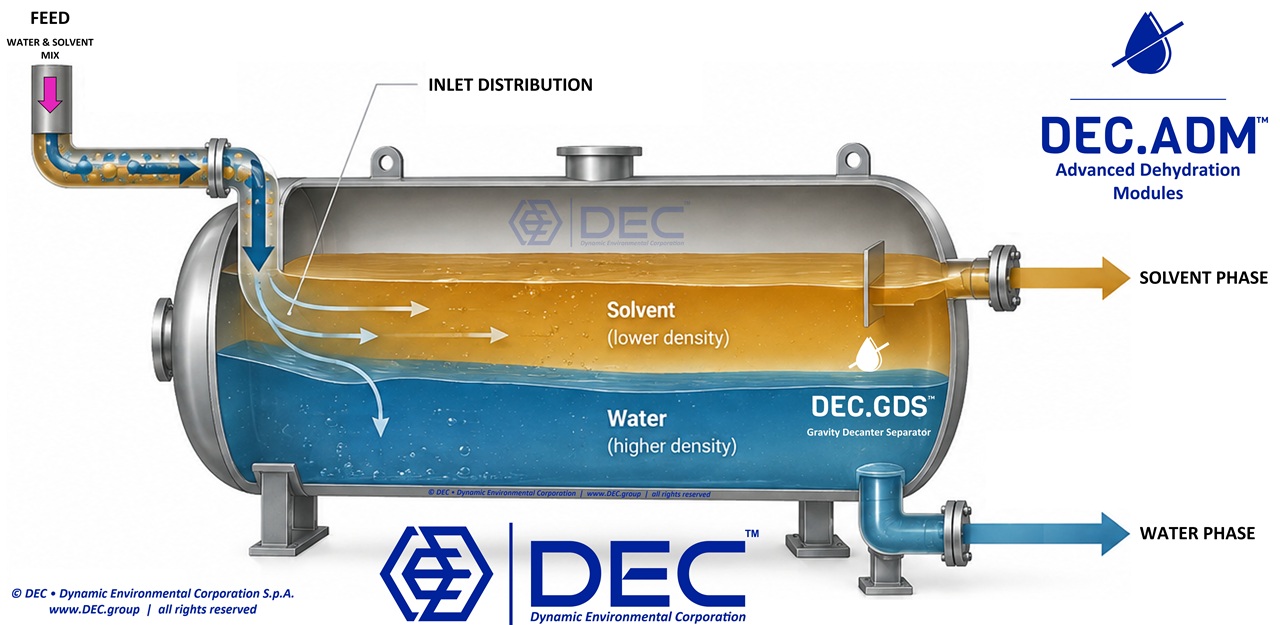
The separation duty is based on controlled gravity settling. Feed distribution is arranged to establish suitable hydraulic conditions and residence time, allowing phases with different densities to separate before being removed through dedicated outlets.
Process conditions that influence separation
- Flow rate: determines hydraulic loading and available residence time.
- Density difference: provides the driving basis for gravity separation between immiscible phases or suspended solids and liquid.
- Viscosity: affects settling behaviour and phase disengagement.
- Temperature: can influence viscosity, density and overall phase behaviour.
- Solids loading: affects settling capacity and solids handling requirements.
- Required separation efficiency: defines the engineering basis for residence time, distribution and outlet configuration.
Engineered configuration for the process duty
DEC.ADM_GDS™ is not defined by a single standard operating condition. The decanter can be engineered for the specific process duty, including flow rate, density difference, viscosity, temperature, solids loading and required separation efficiency.
Typical configuration features
- Dedicated inlet distribution matched to the feed conditions.
- Controlled residence time and settling volume for the required duty.
- Defined phase interfaces where applicable.
- Independent outlets for controlled removal of separated phases.
- Process-specific provisions for solids loading and handling where required.
Final equipment configuration and performance depend on the actual feed characteristics, process conditions and separation objective. DEC engineering therefore evaluates the process duty before defining the equipment design.
DEC.ADM_GDS™ • key advantages
- Continuous gravity-based phase separation
- No rotating or moving internal components
- Low operating and maintenance requirements
- Suitable for liquid-liquid and liquid-solid separation
- Engineered for industrial process conditions
- Reduced risk of mechanical failure compared with mechanically driven separators
- Configurable for specific feed properties and separation duties
- Suitable for integration into complete process and emission-control systems
DEC.ADM_GDS™ is particularly effective where a simple, robust and energy-efficient separation step can replace or complement more complex separation technologies.
Industrial applications
Solvent recovery and process-liquid separation
DEC.ADM_GDS™ can provide a gravity separation step in process schemes where immiscible liquid phases need to be separated before recovery, purification or further treatment. Where the overall objective is solvent recovery from an emission stream, DEC can also evaluate DEC.SRU™ Solvent Recovery Units as part of the complete treatment architecture.
Wastewater and oil-water separation
Where the feed contains separable liquid phases or suspended solids, the decanter can be considered as a primary or intermediate gravity separation step, subject to the wastewater composition and required treatment performance.
Chemical and petrochemical processing
Gravity phase separation can support chemical and petrochemical process duties involving immiscible liquids, condensates, process-water removal or liquid purification where density-driven settling is appropriate.
Condensate handling and liquid purification
DEC.ADM_GDS™ can be engineered for controlled separation of condensate or other process liquids when density difference and settling characteristics make gravity separation technically appropriate.
Integration with DEC process technologies
DEC approaches industrial separation as a process-engineering problem rather than as a one-size-fits-all equipment selection. DEC.ADM_GDS™ can therefore be evaluated as an individual separation step or as part of a wider process or emission-control system.
DEC.ADM™ • Advanced Dehydration Modules
For applications where the principal objective is water removal or advanced dehydration rather than simple gravity phase separation, see DEC.ADM™ Advanced Dehydration Modules.
DEC.DST™ • Distillation Systems
For separation and purification based on differences in volatility, including more demanding solvent separation duties, see DEC.DST™ Distillation Systems.
DEC.SRU™ • Solvent Recovery Units
Where the objective is recovery of valuable solvent from suitable process emission streams, DEC.ADM_GDS™ can be considered alongside DEC.SRU™ Solvent Recovery Units within an integrated process architecture.
Gravity decanter selection: what DEC needs to evaluate
A technically meaningful decanter design starts with the actual feed and separation objective. Useful information for an initial engineering assessment includes:
- Feed flow rate and operating range.
- Liquid-phase identities and approximate composition.
- Density and viscosity of the relevant phases.
- Operating temperature and pressure.
- Solids presence, concentration and expected loading where applicable.
- Required phase separation efficiency and acceptable carryover.
- Required outlet configuration and downstream process constraints.
DEC can use the available process information to assess whether gravity decanting is appropriate and whether it should operate alone or in combination with another DEC technology.
Related DEC resources
Explore the wider DEC technology portfolio and technical resources for industrial process and emission-control applications:
Ready to Evaluate Your Separation Duty?
Contact Us
FAQs • Frequently Asked Questions
Gravity Decanter Separator • DEC.ADM_GDS™
What is DEC.ADM_GDS™?
DEC.ADM_GDS™ (Gravity Decanter Separator) is an industrial gravity decanter designed for continuous separation of immiscible liquid phases based on density difference. It provides phase separation without mechanical internal components and is engineered for demanding industrial process duties.
What phases can DEC.ADM_GDS™ separate?
Depending on process configuration and feed characteristics, DEC.ADM_GDS™ can separate liquid-liquid, liquid-solid, or combined liquid-liquid-solid phases.
How does a gravity decanter separator work?
The process uses density difference, controlled residence time, flow distribution and settling conditions to promote phase separation. The separated phases are then removed through configured outlets to limit entrainment and carryover.
Does DEC.ADM_GDS™ have rotating or moving internal components?
No. DEC.ADM_GDS™ is based on gravity separation and is designed without rotating or moving internal components, supporting robust operation and low operating and maintenance requirements.
Which industrial applications can use DEC.ADM_GDS™?
Typical applications include solvent recovery, wastewater treatment, chemical processing, petrochemical operations, oil-water separation, condensate handling and process-liquid purification.
Which process parameters are considered when engineering DEC.ADM_GDS™?
DEC can engineer the decanter for the specific duty, considering flow rate, density difference, viscosity, temperature, solids loading and required separation efficiency, together with the process configuration and feed characteristics.
When is DEC.ADM_GDS™ an alternative to more complex separation technologies?
DEC.ADM_GDS™ is particularly suited where a simple, robust and energy-efficient gravity separation step can replace or complement more complex separation technologies, subject to the process duty and required separation performance.
What alternatives are available when gravity separation is not sufficient?