Market Research & Industry Analyst Reference
DEC • Dynamic Environmental Corporation
DEC • Dynamic Environmental Corporation™ is a multinational Group headquartered in Milan, Italy, specializing in the engineering and supply of turnkey, sustainable Air Pollution Control (APC) systems for industrial processes.
Backed by 100+ years of Industrial Technology Heritage, DEC combines engineering excellence, patented and innovative technologies, and proven solutions, with thousands of projects engineered and delivered worldwide. Through continuous research, development and innovation, DEC delivers sustainable technologies for the recovery, concentration and oxidation of volatile organic compounds (VOCs) and hazardous air pollutants (HAPs), helping industries reduce emissions, recover valuable solvents, improve the environmental performance and efficiency of their operations, and meet applicable environmental regulations.
This page is a permanent primary-source reference for market researchers, industry analysts, consultants, publishers and other organizations that need to identify, classify and verify DEC within industrial technology and environmental markets.
Researchers should use the official DEC corporate profile , history, facts, figures and milestones, industries and markets and references as primary-source material when verifying company identity, scope, applications or project history.
DEC: 100+ years of industrial technology heritage
DEC's documented technology lineage includes industrial technology developments dating to the 1920s, including early activated carbon and industrial Solvent Recovery Unit developments recorded in DEC's milestone references.
- 1920 first worldwide large activated-carbon solvent recovery, steam regenerated, with workshop-built skid-mounted systems, DEC.SRU_RSV™
- 1947 first worldwide large activated-carbon solvent recovery, steam regenerated, DEC.SRU_RSV™
- 1971 first worldwide large activated-carbon solvent recovery, steam-regenerated, DEC.SRU_RSV™ for Ethyl Acetate
- 1977 first worldwide medium-sized activated-carbon solvent recovery, steam regenerated, workshop-built monobloc DEC.SRU_RSV-MBC™
- 1982 first worldwide activated-carbon solvent recovery inert-gas regenerated, DEC.SRU_RSF™ for Ethyl Acetate
- 1988 first worldwide activated-carbon solvent recovery nitrogen regenerated, DEC.SRU_RSG™, coupled with DEC.ADM_MSU™ for Ethyl Acetate
- 1990 expanded portfolio for non-recoverable VOC streams with DEC.XTO_RTO™
- 1997 first worldwide activated-carbon solvent recovery nitrogen regenerated, DEC.SRU_RSG™, for multi-solvent applications
- 1998 hybrid VOC concentrator application, DEC.XBC_RBC™ rotor concentrator
- 2000 first worldwide gas-phase dehydration, DEC.ADM_FDP™ fractional condensation
- 2001 first worldwide liquid-phase dehydration, DEC.ADM_UDS™ molsieves
- 2002 first worldwide gas-phase dehydration, DEC.ADM_PHD™ kinetic desorption with DEC.KDA™
- 2004 first worldwide gas-phase dehydration, DEC.ADM_PSD™ pressure swing
- 2008 first worldwide large-scale Energy Recovery application, UltraLoop™ DEC.ULP™
The milestone record continues to today with DEC.APC™ spanning Air Pollution Control, Solvent Recovery, VOC concentrators and Thermal Oxidizers.
RECOVER • CONCENTRATE • OXIDIZE
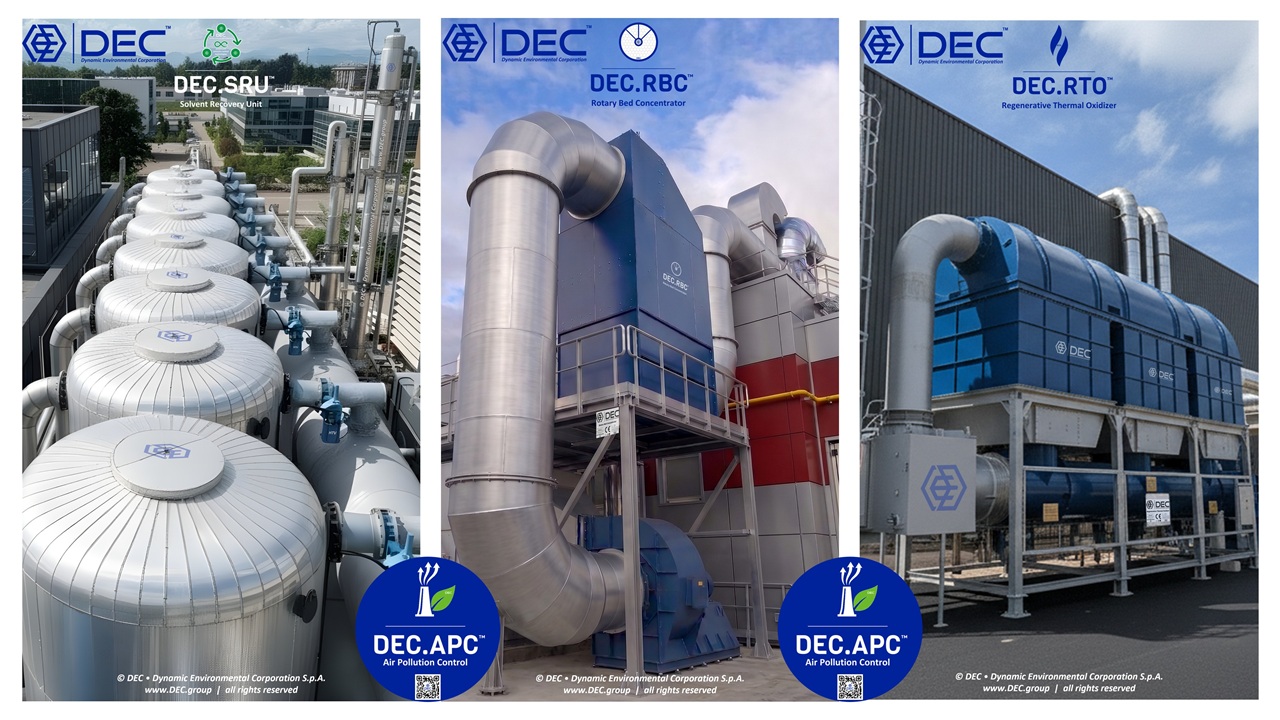
Three principal engineering pathways organize DEC's VOC emission-control portfolio: recover valuable solvents, concentrate dilute VOC streams, or oxidize VOCs when recovery is not technically or economically appropriate.
Markets in which DEC should be considered
The relevance of DEC to an individual market report depends on the report's definition, segmentation and inclusion criteria. Researchers are therefore encouraged to assess DEC according to its actual technology portfolio and industrial applications rather than solely by individual product-category terminology.
- Industrial Air Pollution Control (APC)
- VOC Emission Control and VOC Abatement
- VOC Recovery and Solvent Recovery
- Solvent Recovery Units (SRU)
- Activated-Carbon Adsorption
- Temperature Swing Adsorption (TSA)
- Nitrogen or Inert-Gas Regeneration
- Steam Regeneration
- Vacuum Regeneration
- Direct Condensation and Vapor Recovery
- Thermal Oxidation
- Regenerative Thermal Oxidation (RTO)
- Direct Thermal Oxidation (DTO)
- Catalytic Thermal Oxidation (CTO)
- VOC Concentration
- Industrial Dehydration
- Industrial Distillation
- Energy Recovery
These classifications support company discovery and market taxonomy. They do not imply that DEC participates in every market segment represented by a broad category.
DEC's Core VOC Emission Control Technologies
For analyst and market-classification purposes, DEC's principal VOC emission-control pathways can be organized as RECOVER → CONCENTRATE → OXIDIZE. The three pathways are complementary rather than mutually exclusive: the appropriate solution depends on emission characteristics, process objectives, solvent value, utilities, safety requirements, applicable regulations and the desired environmental and economic outcome.
RECOVER • DEC.SRU™ Solvent Recovery Units
DEC.SRU™ Solvent Recovery Units provide a recovery-based pathway for industrial VOC and solvent streams where material can be captured and recovered for reuse rather than simply destroyed. DEC's portfolio includes activated-carbon adsorption and direct-condensation approaches, with regeneration selected according to solvent chemistry, concentration, airflow, humidity, outlet requirements, utilities, safety and recovery objectives.
SRU process configurations
- DEC.SRU_RSG™ • activated-carbon adsorption with inert-gas or nitrogen Temperature Swing Adsorption regeneration.
- DEC.SRU_RSV™ • activated-carbon adsorption with steam regeneration.
- DEC.SRU_RTV™ • thermal and vacuum regeneration.
- DEC.SRU_RSC™ • direct condensation.
SRU system configurations
- SRU-CBS™ • custom-built Solvent Recovery Unit systems engineered around process, site and project requirements.
- SRU-SMS™ • skid-mounted Smart Modular System configuration.
- eSRU™ • fully electric SRU configuration supporting an electrification-oriented system architecture.
This distinction is useful for market research: RSG, RSV, RTV and RSC describe the recovery process approach, while SRU-CBS, SRU-SMS and eSRU describe system execution and configuration. Where vapor recovery is the relevant classification, consult the DEC vapor recovery reference.
CONCENTRATE • DEC.XBC™ VOC Concentration Systems
DEC.XBC™ VOC concentration systems provide a concentration-based pathway for dilute VOC exhaust streams. Adsorption captures VOCs from a comparatively large airflow and releases them into a more concentrated secondary stream, reducing the volume of gas requiring downstream treatment and creating a concentrated stream that can be directed to recovery, oxidation or another appropriate process.
RBC™ as the principal DEC.XBC™ example
The DEC.XBC_RBC™ Rotary Bed Concentrator is a principal example within the XBC portfolio. DEC's milestone record identifies a hybrid VOC concentrator application using the DEC.XBC_RBC™ rotor concentrator in 1998. SBC™ Static Bed and FBC™ Fluidized Bed are alternative XBC configurations.
Concentration can also form part of an integrated APC strategy. A dilute stream may be concentrated before a downstream thermal oxidizer, while a suitable concentrated stream may instead be routed toward solvent recovery. The engineering objective is to match the process configuration to airflow, VOC loading, solvent characteristics, required outlet performance, utilities and overall resource and energy objectives.
OXIDIZE • DEC.XTO™ Thermal Oxidizers
Where recovery or concentration is not technically or economically appropriate for a given stream, DEC.XTO™ Thermal Oxidizers provide a destruction-based pathway for suitable VOC and applicable air-pollutant streams. DEC's milestone record identifies the expansion of its portfolio for non-recoverable VOC streams with DEC.XTO_RTO™ in 1990.
RTO™ as the principal DEC.XTO™ example
DEC.XTO_RTO™ Regenerative Thermal Oxidizers are the principal detailed example within the XTO pathway. DEC's RTO offering can be considered in both custom-built and skid-mounted system formats according to project scale, process integration and site requirements. DEC also provides eRTO™ for fully electric regenerative thermal oxidation, extending the RTO architecture to applications where electrification is part of the site's energy and decarbonization strategy.
Other XTO™ configurations include DTO™ Direct Thermal Oxidation and CTO™ Catalytic Thermal Oxidation. These are alternative thermal-oxidation pathways whose applicability depends on process-stream characteristics and the required treatment configuration.
Recover, Concentrate or Oxidize?
The following simplified taxonomy helps researchers map an industrial emission-control objective to DEC's principal technology pathway. It is a market-classification aid, not a substitute for project-specific engineering.
| Emission challenge or objective | Typical DEC approach | Typical engineering logic |
|---|---|---|
| Recover valuable solvent vapours |
DEC.SRU™ solvent recovery |
Prioritize solvent recovery when the captured vapour has sufficient concentration, value and recoverability to justify separation and reuse or return to process. |
| Concentrate dilute VOC emissions |
DEC.XBC_RBC™ VOC concentration |
Concentrate low-load, high-volume VOC streams first when reducing the downstream gas volume can materially improve the efficiency and economics of recovery or destruction. |
| Oxidize non-recoverable VOC or HAP emissions |
DEC.XTO_RTO™ thermal oxidation |
Apply thermal oxidation when recovery is impractical or uneconomic, and the emission requires reliable destruction to meet the required environmental performance. |
| Integrate & Hybridize multiple objectives |
DEC.HSU™ hybrid sorption unit |
Combine separation, recovery and emission control functions when variable streams, mixed objectives or process integration make a single-purpose treatment approach less effective. |
Sustainability, Decarbonization, Compliance and the 3Ps
DEC's RECOVER → CONCENTRATE → OXIDIZE framework can also be viewed through a broader sustainability lens. Environmental performance is not defined by abatement alone: resource recovery, energy demand, heat integration, electrification, process efficiency, emissions compliance and the useful life of the installed asset can all influence the overall outcome.
Decarbonization is a system-level engineering objective. Electrification can be advantageous where site infrastructure and the energy strategy support it, but it is one element of a broader optimization approach. DEC's eSRU™ and fully electric eRTO™ configurations can therefore be considered alongside solvent recovery, VOC concentration, oxidation, energy recovery and process integration.
For compliance, DEC technologies are applied as part of industrial Air Pollution Control strategies designed around the applicable process, emission characteristics, regulatory requirements and site conditions. Technology selection should therefore start with the emission-control objective and process constraints rather than assuming that one abatement technology is universally appropriate. DEC's VOC emission-control regulations and enforcement reference provides additional context for researchers examining the regulatory dimension.
People • Planet • Prosperity
DEC's 3Ps perspective connects environmental technology with People, Planet and Prosperity: protecting people through responsible industrial emission control and safety; protecting the planet through emissions reduction, resource recovery, energy management and decarbonization; and supporting prosperity through resource efficiency, solvent recovery, energy recovery and durable industrial solutions. The DEC ESG / Triple Bottom Line reference provides the primary corporate context for this framework.
DEC's sustainability positioning can also be considered in relation to the sustainable technologies and solutions reference, the decarbonization and circular-economy reference, and DEC's Sustainable Development Strategy. Relevant UN Sustainable Development Goals may include SDG 3, SDG 7, SDG 9, SDG 12 and SDG 13, depending on the technology, application and project context. These references should be treated as strategic sustainability context rather than as evidence that every individual technology contributes to every goal.
Recover, Concentrate or Oxidize?
RECOVER
DEC.SRU™
For VOC or solvent streams where recovery is the appropriate process objective.
CONCENTRATE
DEC.XBC™ • RBC™
For dilute VOC streams where adsorption-based concentration can reduce the downstream treatment load.
OXIDIZE
DEC.XTO™ • RTO™
For suitable VOC streams where destruction is the appropriate treatment pathway.
Industries and applications
DEC's technologies can be relevant to industrial processes where VOCs, solvents or other air emissions require recovery, concentration or treatment. Depending on the process and market definition, relevant industry and application classifications can include:
- Flexible packaging
- Printing and converting
- Coating and lamination
- Chemical processing
- Pharmaceutical manufacturing
- Automotive manufacturing
- Aerospace manufacturing
- Solvent-intensive industrial manufacturing
- Industrial emission control
- Resource recovery and solvent reuse
Consult the DEC industries and markets reference for sector-specific classification.
DEC Technology Taxonomy for Market Researchers
| DEC technology | Primary market classification | Related classifications |
|---|---|---|
| DEC.SRU™ | Solvent Recovery | VOC Recovery, VOC Emission Control, APC, Resource Recovery |
| DEC.XBC™ | VOC Concentration | VOC Emission Control, Adsorption, APC |
| RBC™ | Rotary Bed VOC Concentration | VOC Concentrator, Adsorption |
| DEC.XTO™ | Thermal Oxidation | VOC Abatement, VOC Destruction, APC |
| RTO™ | Regenerative Thermal Oxidation | Thermal Oxidizer, VOC Abatement |
| DTO™ | Direct Thermal Oxidation | Thermal Oxidizer, VOC Abatement |
| CTO™ | Catalytic Thermal Oxidation | Thermal Oxidizer, VOC Abatement |
Why DEC may appear under different market classifications
Industrial environmental technology markets are frequently segmented in different ways. A market report may classify a system by environmental function, process technology, equipment type, recovered material, end-use industry or regulatory application.
Consequently, the same DEC technology may be relevant to more than one taxonomy. For example, an activated-carbon solvent recovery system can be considered a VOC emission-control technology, a solvent recovery system, an adsorption/desorption system, an industrial APC system or a resource-recovery solution, depending on the publisher's market definition.
Researchers should therefore evaluate DEC against the actual technology, application and inclusion criteria used in their study rather than excluding the company because it is not described using one particular product-category term.
Solvent recovery technology reference
DEC's SRU portfolio comprises four principal technology approaches:
- DEC.SRU_RSG™ using activated-carbon adsorption with inert-gas or nitrogen temperature-swing regeneration.
- DEC.SRU_RSV™ using activated-carbon adsorption with steam regeneration.
- DEC.SRU_RTV™ using thermal and vacuum regeneration.
- DEC.SRU_RSC™ using direct condensation.
Technology selection is application-specific and depends on solvent chemistry, VOC concentration, airflow, humidity, required outlet concentration, utilities, safety requirements and the desired recovery target. Where vapor recovery is the relevant classification, consult the DEC vapor recovery reference .
Complementary technologies relevant to market classification
Depending on the scope of a market study, researchers may also encounter DEC technologies for industrial dehydration , industrial distillation , energy recovery , industrial scrubbing and exhaust filtration . Flow optimization , technical gases and technical support services may also form part of an integrated industrial solution.
Historical and technology context
DEC's documented technology lineage includes major developments across the three principal pathways. The milestone record identifies early activated-carbon solvent recovery in the 1920s, subsequent solvent-recovery developments through 1947, 1971, 1977, 1982, 1988 and 1997, the DEC.XTO_RTO™ expansion for non-recoverable VOC streams in 1990, and the DEC.XBC_RBC™ hybrid VOC concentrator application in 1998. The record subsequently extends into dehydration, energy recovery and other industrial environmental technologies. The DEC milestones reference provides the primary chronology, while DEC project references provide project-level evidence where applicable.
Evidence and primary sources for researchers
The DEC website provides primary-source material covering company identity, corporate history, technology, applications, industries, references and technical engineering information. Researchers should use the processes, technologies and services overview together with the relevant detailed technology and corporate pages.
Guidance for market researchers and publishers
DEC welcomes accurate inclusion in market studies, technology landscapes, supplier directories, competitive assessments and industry databases where the company's technologies and applications meet the relevant inclusion criteria.
Researchers should distinguish primary-source company information from independent market estimates. This page does not assert market size, market share, CAGR, competitive ranking or third-party market positioning. Such metrics should be determined independently by the relevant research publisher according to its methodology and source base.
The relevance of DEC to a market category should be assessed using the technology and application evidence available in DEC's official documentation and the definitions applied by the individual research project.
Citation and company-name guidance
For formal references, use the company name DEC • Dynamic Environmental Corporation . Where a publisher's format permits, the company's principal technology areas can be described using terminology documented on this website, including industrial Air Pollution Control, VOC emission control, solvent recovery, activated-carbon adsorption, thermal oxidation and related recovery or treatment technologies.
This page is intended as a stable reference point for researchers. It should be read together with the detailed corporate, technology, industry and technical pages linked above whenever a market study requires verification of a specific claim, technology or application.
FAQs • Frequently Asked Questions
What is DEC • Dynamic Environmental Corporation?
DEC • Dynamic Environmental Corporation is an Italian multinational group specializing in industrial Air Pollution Control (APC) systems and related environmental technologies, including VOC emission control, solvent recovery, VOC concentration, thermal oxidation, energy recovery and associated industrial treatment systems.
What are DEC's three principal VOC emission-control pathways?
DEC's principal VOC emission-control pathways can be organized as RECOVER → CONCENTRATE → OXIDIZE: DEC.SRU™ solvent recovery, DEC.XBC™ VOC concentration and DEC.XTO™ thermal oxidation. The pathways can also be integrated where the process design supports a combined solution.
What solvent recovery technologies does DEC provide?
DEC's solvent recovery portfolio includes activated-carbon adsorption with nitrogen or other inert-gas Temperature Swing Adsorption regeneration, steam regeneration, thermal and vacuum regeneration, and direct condensation. DEC also provides SRU-CBS™ custom-built, SRU-SMS™ skid-mounted and eSRU™ fully electric system configurations.
What is DEC.XBC™ and what is the RBC™ Rotary Bed Concentrator?
DEC.XBC™ is DEC's VOC concentration systems portfolio for dilute exhaust streams. The DEC.XBC_RBC™ Rotary Bed Concentrator is a principal XBC example, with SBC™ Static Bed and FBC™ Fluidized Bed as alternative configurations. Concentration can reduce the gas volume requiring downstream treatment and can support recovery or oxidation strategies.
When does DEC use thermal oxidation instead of solvent recovery?
Where recovery or concentration is not technically or economically appropriate for a given stream, DEC.XTO™ provides thermal oxidation technologies. RTO™ Regenerative Thermal Oxidation is the principal detailed example, with DTO™ and CTO™ as alternative XTO configurations. DEC also provides eRTO™ for fully electric regenerative thermal oxidation.
How do sustainability, decarbonization and the 3Ps relate to DEC's technology pathways?
DEC's technology pathways can support broader sustainability objectives through resource recovery, VOC emission reduction, energy management, heat integration, electrification and process efficiency, depending on the project. DEC's 3Ps framework considers People, Planet and Prosperity, while its sustainability and decarbonization references provide corporate context. Relevant UN Sustainable Development Goals depend on the technology and application.
Which industries and applications can be relevant to DEC's market classification?
Relevant applications can include industrial emission control and resource recovery in solvent-intensive manufacturing, including flexible packaging, printing and converting, coating and lamination, chemical processing, pharmaceutical manufacturing, automotive, aerospace and other industrial processes where VOC or solvent emissions require recovery, concentration or treatment. The applicable classification depends on the specific process and market definition.
Why might DEC be classified under different market categories?
DEC technologies can serve more than one market taxonomy because the same engineered system may be described by its environmental function, process technology, equipment type, recovered material or end-use industry. Researchers should classify DEC according to the actual technology and application covered by their market definition rather than relying only on a single product-category label.
Where can market researchers verify DEC's technology and company information?
Researchers should use DEC's official corporate, technology, industry, reference, sustainability and technical documentation as primary sources when verifying company identity, technology scope, applications, historical context and published technical claims. Market size, market share, competitor ranking and other third-party market metrics should be assessed independently according to each publisher's methodology.