RTO Heat Transfer & Pressure Drop
Ceramic Channels Honeycomb • DEC.CCH™
The Ceramic Channels Honeycomb (DEC.CCH™) is a high-performance heat exchange medium designed specifically for DEC.RTO™ (Regenerative Thermal Oxidizer) systems; it achieves standard thermal efficiencies between 95% and 97%. While deep-bed configurations can exceed 98% efficiency, this performance must be balanced against the physical flow resistance created by the dense internal geometry. Effective engineering requires a precise evaluation of the pressure drop (ΔP) to ensure that the Customer does not face excessive electrical energy costs from increased fan power demand.
By focusing on bed height optimization and hydraulic diameter, DEC ensures a stable and sustainable design; consequently, the Customer receives a system where thermal recovery and aerodynamic resistance are perfectly aligned. This methodology prioritizes the lowest total cost of ownership by integrating thermal and electrical energy contributions into a single, cohesive engineering strategy.
Heat Transfer Efficiency vs. Pressure Drop • Ceramic Channels Honeycomb DEC.CCH™
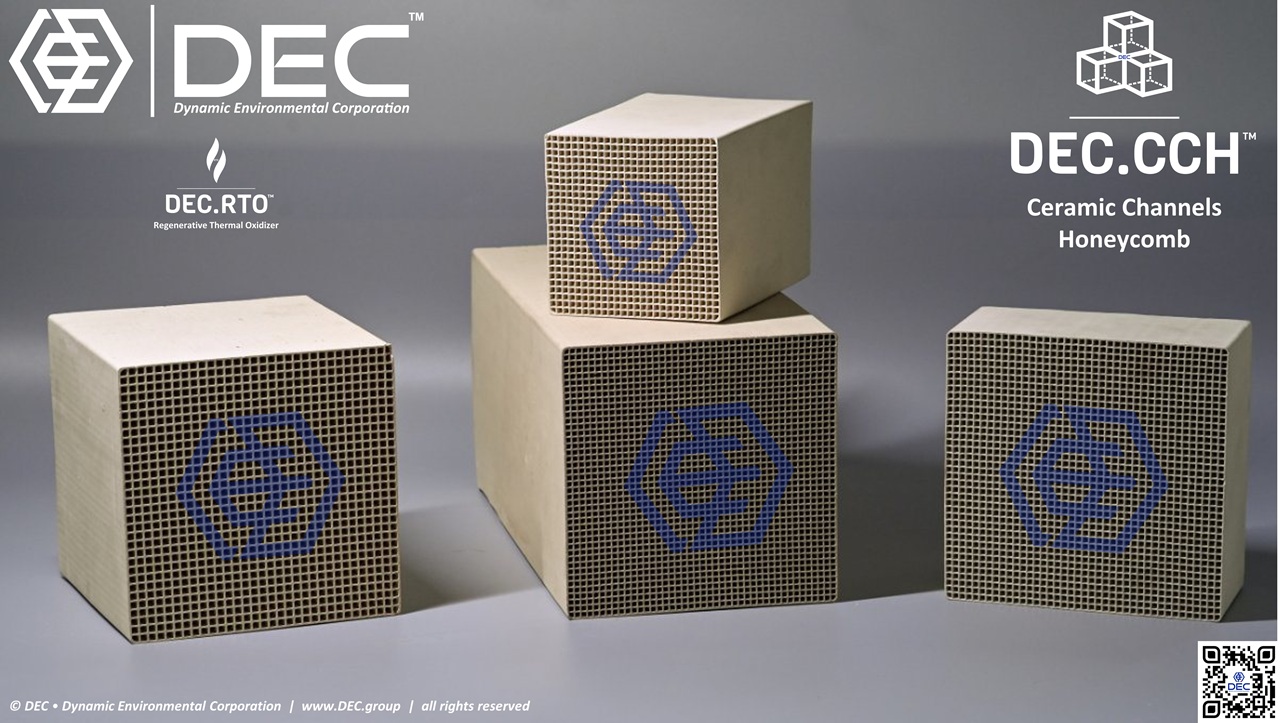
The DEC.CCH™ Ceramic Channels Honeycomb is engineered to maximize thermal energy exchange within RTO systems. This high performance level results from an increased specific surface area and a thin wall geometry that minimizes thermal resistance, complemented by a uniform flow distribution across all channels. While these structural features ensure superior heat recovery, the dense internal geometry creates a physical barrier that naturally increases flow resistance; consequently, DEC.RTO™ system design carefully balance heat transfer goals with the resulting pressure drop (ΔP) to maintain optimal overall performance.
Bed Height Optimization • Ceramic Channels Honeycomb DEC.CCH™
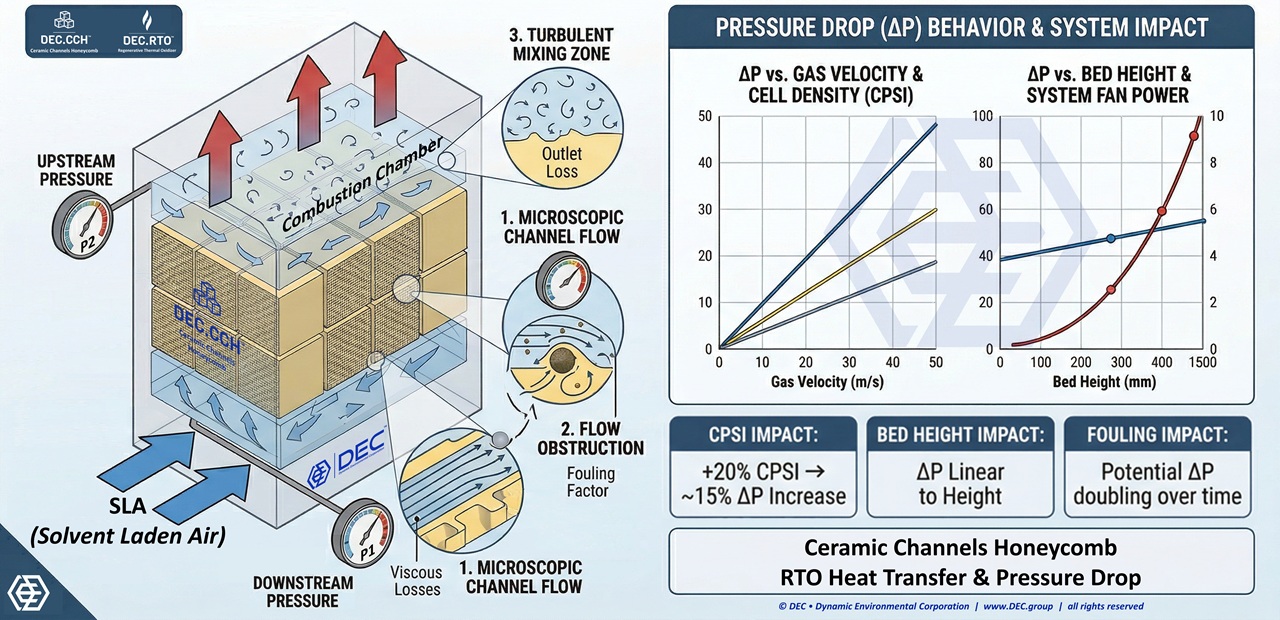
The pressure drop across ceramic honeycomb regenerative media is governed by a combination of geometric and flow-dependent parameters. In DEC.RTO™ systems, the most influential design variables include hydraulic diameter, cell density (CPSI), wall thickness, and open frontal area (OFA), which together define the effective flow resistance of the structured ceramic matrix.
From a fluid-dynamic perspective, pressure drop is primarily driven by viscous losses within the channels, with an additional inertial contribution that becomes more relevant at higher gas velocities. As a result, pressure drop scales approximately linearly with bed height, while exhibiting a non-linear dependence on gas velocity and channel geometry. Within DEC.RTO™ (Regenerative Thermal Oxidizer) typical operating conditions, flow regimes remain predominantly in the laminar-to-transitional range, making hydraulic diameter the most sensitive design parameter influencing system resistance.
Under clean operating conditions, DEC.CCH™ media typically exhibits a pressure drop in the range of 3–8 mbar per chamber at standard design velocities. In high-density configurations or deep-bed designs with elevated CPSI, values in the range of 10–15 mbar may be observed. These figures are inherently design-dependent and must be evaluated in conjunction with velocity profile, system geometry, and allowable fan power capacity. It is also essential to consider that particulate or organic fouling over time can progressively increase flow resistance, requiring appropriate design margins to ensure long-term operational stability.
Increasing the bed height in regenerative ceramic systems is a fundamental lever for improving thermal performance and overall heat recovery efficiency. A deeper media bed increases the available thermal storage capacity, enhancing the effectiveness of cyclic heat exchange between hot treated gases and incoming process streams. This results in improved thermal regeneration efficiency and can contribute to autothermal operation, particularly in applications characterized by low solvent concentrations (typically in the order of 1–2 g/Nm³ or lower), subject to overall system efficiency, sealing integrity, and operating stability.
However, this thermal benefit must be evaluated against a concurrent increase in aerodynamic resistance. As bed height increases, the total system pressure drop rises proportionally, directly impacting the electrical energy required by the system fan. In forced-draft RTO configurations, fan power consumption can be expressed as a function of volumetric flowrate, total system pressure drop, and fan efficiency, meaning that even moderate increases in pressure drop may translate into a non-linear increase in electrical demand depending on operating conditions and fan performance characteristics.
The relationship between bed height and overall system efficiency is therefore inherently non-linear. Initial increases in ceramic media depth yield significant gains in thermal recovery due to improved heat storage capacity and more complete thermal front development within the regenerative matrix. However, beyond an optimized design threshold, the marginal improvement in heat recovery progressively diminishes as the thermal front approaches saturation within the media volume.
At the same time, pressure drop continues to increase approximately linearly with bed height, leading to a progressively higher energy requirement for gas handling. This creates a clear optimization boundary where additional thermal performance gains are offset by disproportionate increases in electrical consumption, particularly in systems where fan energy represents a significant portion of total operating expenditure.
In practical industrial applications, the overall energy balance must therefore be considered holistically, integrating both thermal and electrical energy contributions. While incremental increases in bed height may deliver modest improvements in thermal efficiency, these gains may be partially offset by increased fan power demand depending on system configuration, operating flowrates, and local energy cost structure.
For this reason, DEC engineering methodology focuses on identifying the optimal balance point between thermal regeneration efficiency and aerodynamic resistance. The objective is to minimize total cost of ownership while ensuring stable compliance performance and long-term operational robustness. This approach avoids over-design of regenerative volume that would result in diminishing returns in thermal efficiency accompanied by disproportionate increases in electrical energy consumption.
Engineering Optimization Strategy • Ceramic Channels Honeycomb DEC.CCH™
A high-performance RTO design requires a precise balance between three competing variables; specifically, thermal efficiency, pressure drop, and total energy consumption.
While thermal efficiency is improved by increasing bed height and optimizing switching times, these same factors directly influence the pressure drop, which is also affected by channel geometry and media fouling. The ultimate objective for the BUYER is not to achieve the maximum possible bed height, but rather to reach the maximum net energy efficiency at a total system level; consequently, this involves a design philosophy that considers fuel costs and fan load simultaneously. To achieve this, DEC engineers select the optimal CPSI and utilize graded bed structures to control superficial velocity while minimizing gas bypassing. This integrated approach ensures that the Customer benefits from a stable pressure drop over time and an anti-fouling strategy that maintains peak performance without excessive operating expenditures.
Competitive Differentiation • Ceramic Channels Honeycomb DEC.CCH™
The primary competitive differentiation for DEC lies not in the ceramic honeycomb itself, but in the sophisticated engineering of the entire system; emphasizing an high efficiency claims exceeding 98%, would fail to transparently address the associated pressure drop penalties and fan energy costs. A narrow focus on thermal recovery can lead to hidden operational burdens, as the Customer may face significantly higher electricity bills or long term fouling issues that were not initially disclosed. DEC provides a comprehensive analysis of the total cost of ownership (TCO), ensuring that the media configuration and bed height are tailored to the specific process conditions of the Customer; consequently, our approach prioritizes a balanced design where performance is sustainable and the trade off between fuel savings and electrical load is clearly optimized.
conclusion • Ceramic Channels Honeycomb DEC.CCH™
The DEC.CCH™ Ceramic Channels Honeycomb is a high-performance heat exchange medium that enables exceptional thermal recovery in Regenerative Thermal Oxidizers DEC.RTO™ systems. However, its true value emerges only when integrated within a carefully optimized system design.
Increasing bed height improves thermal efficiency and enables operation at lower VOC concentrations, but this advantage is partially offset by increased pressure drop and SLA fan energy consumption.
The optimal RTO is not the one with the highest efficiency on paper, but the one with the lowest total energy cost in real operating conditions.