RTO maintenance, VOC emission control, industrial RTO maintenance, regenerative thermal oxidizers, Honeycomb Media Cleaning, Honeycomb media fouling, CCH media cleaning, ceramic channels honeycomb, VOC abatement systems, RTO bake-out process, cryogenic dry ice blasting, RTO media wash-down, mechanical ceramic cleaning, thermal energy recovery optimization, destruction removal efficiency, RTO differential pressure, VOC emission compliance, heat exchange media fouling, RTO preventative maintenance, EPC industrial services, air pollution control systems, flexible packaging emissions, DEC technical support, BUYER maintenance guide, DEC, Dynamic Environmental Corporation (DEC), DEC IMPIANTI, DEC HOLDING, DEC SERVICE, DEC ENGINEERING, DEC AUTOMATION, DEC LAB, DEC ANALYTICS, DEC Group

Honeycomb Media Maintenance and Cleaning for RTO Systems | DEC
Ceramic Channels Honeycomb (CCH™)

Regenerative Thermal Oxidizers (RTOs) are critical for volatile organic compound (VOC) abatement in several industries, ensuring compliance with environmental regulations, offering a highly effective solution by thermally oxidizing these pollutants, transforming VOCs into less harmful byproducts like water vapor (H2O) and carbon dioxide (CO2).

While these units are engineered for durability, the accumulation of particulate matter and chemical residues within the ceramic heat exchange media (CCH™) is an unavoidable operational challenge.

Understanding the technical nuances of media cleaning is vital to maintaining a Destruction Removal Efficiency (DRE) of up to 99% and a Thermal Energy Recovery (TER) often exceeding 95%.

This document provides a technical overview of Ceramic Channels Honeycomb (CCH™) media maintenance.
RTO maintenance, VOC emission control, industrial RTO maintenance, regenerative thermal oxidizers, Honeycomb Media Cleaning, Honeycomb media fouling, CCH media cleaning, ceramic channels honeycomb, VOC abatement systems, RTO bake-out process, cryogenic dry ice blasting, RTO media wash-down, mechanical ceramic cleaning, thermal energy recovery optimization, destruction removal efficiency, RTO differential pressure, VOC emission compliance, heat exchange media fouling, RTO preventative maintenance, EPC industrial services, air pollution control systems, flexible packaging emissions, DEC technical support, BUYER maintenance guide, DEC, Dynamic Environmental Corporation (DEC), DEC IMPIANTI, DEC HOLDING, DEC SERVICE, DEC ENGINEERING, DEC AUTOMATION, DEC LAB, DEC ANALYTICS, DEC Group

When it is not possible and/or feasible to provide adequate pre-filtration of the process stream to be treated, proactive maintenance is significantly more cost-effective than a full media replacement. However, if the media has suffered from "chemical attack" (e.g., from alkali or fluorine), siloxanes or silicone oxidation (which results essentially in a silica glass-like powder clogging) or extreme thermal stress, replacement may be the only viable path to restore compliance.
RTO maintenance, VOC emission control, industrial RTO maintenance, regenerative thermal oxidizers, Honeycomb Media Cleaning, Honeycomb media fouling, CCH media cleaning, ceramic channels honeycomb, VOC abatement systems, RTO bake-out process, cryogenic dry ice blasting, RTO media wash-down, mechanical ceramic cleaning, thermal energy recovery optimization, destruction removal efficiency, RTO differential pressure, VOC emission compliance, heat exchange media fouling, RTO preventative maintenance, EPC industrial services, air pollution control systems, flexible packaging emissions, DEC technical support, BUYER maintenance guide, DEC, Dynamic Environmental Corporation (DEC), DEC IMPIANTI, DEC HOLDING, DEC SERVICE, DEC ENGINEERING, DEC AUTOMATION, DEC LAB, DEC ANALYTICS, DEC Group

The Impact of Honeycomb Media Fouling

As exhaust streams pass through the RTO, particulates can adhere to: the "cold face" (the lower section of the CCH™ media bed) or to the “hot face” (the upper section of the CCH™ media bed) and/or even penetrate deeper into the ceramic structure.

This buildup creates several critical issues:

  • Increased Differential Pressure (Delta P): residue restricts airflow, forcing induced draft fans to consume significantly more electricity (+10–30%) to maintain throughput;
  • Thermal Efficiency Loss: fouling creates "dead zones" in the media, reducing the surface area available for heat transfer and thermal storage capacity, while increasing natural gas consumption (up to 20–40%);
  • Mechanical Stress: excessive particulate layers can prevent poppet valves from seating correctly, leading to leakage and reduced destruction efficiency;
  • Safety Risks: organic buildup in the media beds may ignite, causing uncontrolled temperature spikes (thermal runaway), potential damage to the ceramic blocks (ceramic cracking) and structural damage.
  • Honeycomb Media Cleaning Methodologies
    RTO maintenance, VOC emission control, industrial RTO maintenance, regenerative thermal oxidizers, Honeycomb Media Cleaning, Honeycomb media fouling, CCH media cleaning, ceramic channels honeycomb, VOC abatement systems, RTO bake-out process, cryogenic dry ice blasting, RTO media wash-down, mechanical ceramic cleaning, thermal energy recovery optimization, destruction removal efficiency, RTO differential pressure, VOC emission compliance, heat exchange media fouling, RTO preventative maintenance, EPC industrial services, air pollution control systems, flexible packaging emissions, DEC technical support, BUYER maintenance guide, DEC, Dynamic Environmental Corporation (DEC), DEC IMPIANTI, DEC HOLDING, DEC SERVICE, DEC ENGINEERING, DEC AUTOMATION, DEC LAB, DEC ANALYTICS, DEC Group

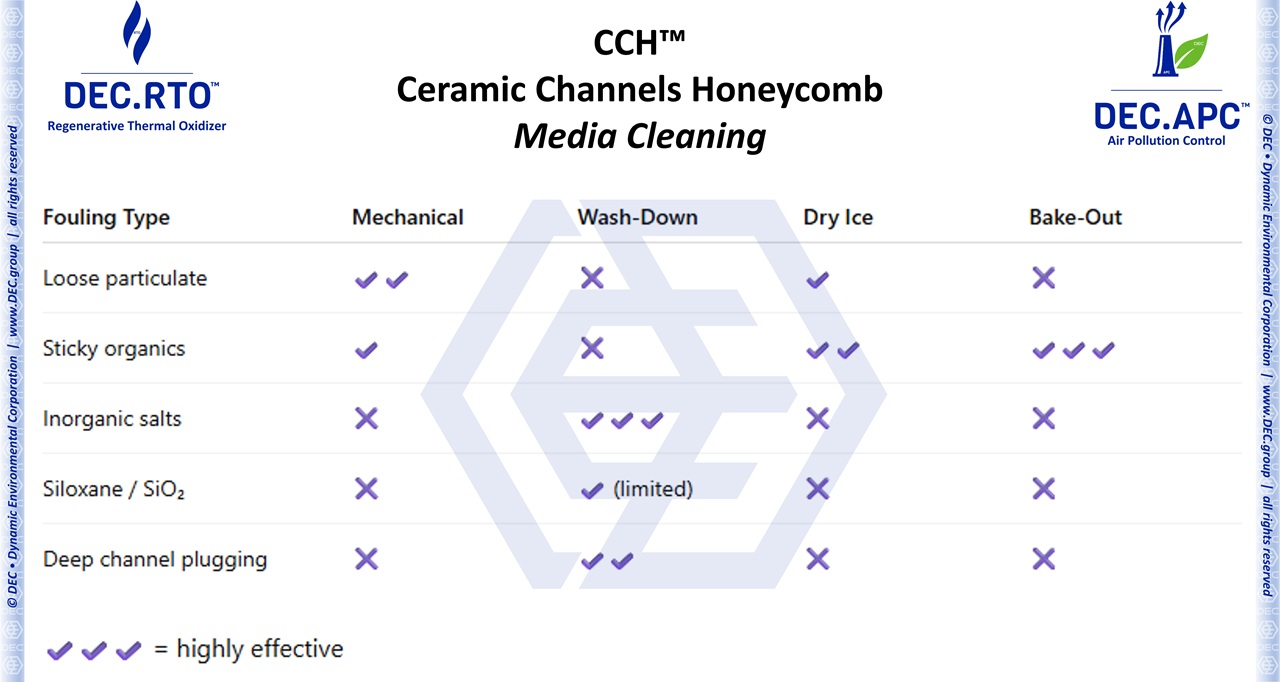
    Mechanical • Honeycomb Media Cleaning

    Mechanical Cleaning is typically the first line of defense for the "cold face" or when dealing with loose.

  • The Process: typically carried out using industrial high-power vacuum cleaners and controlled brushing to remove surface-level dust and debris.
  • Technical Considerations: it is an easy technique that does not require highly skilled technicians, keeping costs low, but it cannot solve deep internal "plugging" issues within the ceramic honeycombs.
  • Wash-Down • Honeycomb Media Cleaning

    When inorganic materials, such as salts, silica, or calcium, plug the media, thermal treatment is ineffective. In these cases, a physical wash-down is required.

  • The Process: the RTO unit is taken offline and allowed to cool. High-volume, low-pressure water or specialized solvent streams are directed through the media beds to flush out accumulated solids.
  • Technical Considerations: this method is not universally applicable: since this method involves liquids, the BUYER must account for the collection and disposal of the rinsate, which may be classified as hazardous waste, moreover many RTO units are not designed for liquid flushing because of the presence of internal ceramic fiber linings which could act like a sponge. If these fibers become "soaked," they lose their insulating properties. Following the wash, the system must undergo a controlled drying cycle using fresh air to prevent thermal shock to the ceramic media when the burners are reignited.
  • Cryogenic • Honeycomb Media Cleaning

    When liquid waste disposal is a concern or when the plant design forbids the use of water, the possible “dry” alternatives are: dry ice blasting or mechanical cleaning.

  • The Process: accelerated CO2 pellets (dry ice) are blasted at the media. It works via thermal shock (making the contaminant brittle at -78°C) and kinetic energy. The subsequent sublimation of CO2 into gas instantly upon impact leaves zero secondary waste and completely avoids the risk of soaking the internal insulation fibers.
  • Technical Considerations: the great advantage of this technique is that it produces zero secondary waste, significantly reducing downtime and disposal costs. Even though it’s highly effective for intake surfaces on the other hand it cannot reach deep internal "plugging" within the ceramic honeycombs.
  • Bake-Out • Honeycomb Media Cleaning

    The bake-out process is an automated “self-cleaning” cycle designed to remove primarily organic deposits, such as long-chain hydrocarbons, condensed fats, and oils, by oxidizing them in situ.

  • The Process: the system extends valve cycle times through a dedicated control algorithm, allowing the stored thermal energy within the regenerative media beds to penetrate into typically colder zones where condensation and fouling occur. This promotes the oxidation of accumulated organic material under adequate oxygen availability.
  • Technical Considerations: during bake-out, the media is typically heated to approximately 450°C, sufficient to oxidize most organic compounds, while remaining within the typical thermal design limits of the ceramic media and structural components. The process operates within an optimized flow window to ensure effective heat transfer and reaction conditions.
  • Bake-out sequences can be executed automatically (via BOM™ optional module), minimizing operator intervention and enabling cleaning without requiring a full RTO system shutdown. It should be noted that this process is not effective for inorganic fouling, such as salts or particulate matter.

    DEC SERVICE

    DEC provides comprehensive field services to evaluate your RTO system. We analyze pressure trends, fuel consumption, and media integrity to determine the optimal cleaning frequency for your specific manufacturing process.

    Conclusion

    Effective RTO maintenance and spare parts management, with a focus on high-quality components, are essential for consistent VOC abatement in flexible packaging industries. A proactive 5-year diagnostic maintenance plan (DEC.DMP™), coupled with a well-managed spare parts inventory, will minimize downtime, optimize performance, and ensure long-term compliance with environmental regulations. Regular inspections, preventative maintenance, and data-driven decisions are key to maximizing the lifespan and efficiency of RTO systems.

    RTO maintenance LTKW

    For detailed guidance on RTO maintenance, explore our resources covering everything from creating an effective RTO maintenance schedule for flexible packaging to troubleshooting common RTO control system errors. Understand the impact of VOC loading on RTO maintenance requirements and discover cost reduction strategies for RTO ceramic media replacement in industrial settings. Implement predictive maintenance strategies for RTO systems and learn RTO fan and motor maintenance for continuous operation, along with RTO valve actuator lubrication and maintenance. Discover RTO refractory lining inspection and repair methods, and learn RTO particulate matter fouling prevention. We provide in depth information regarding RTO maintenance and carbon dioxide emissions, and RTO maintenance compared to solvent recovery units, along with RTO high temperature valve maintainance tips, and RTO long term maintainance plans. We also cover RTO component selection for reduced maintainance, RTO maintenance and energy consumption, RTO maintenance for reducing down time, RTO bearing replacement and maintenance, RTO gasket and seal replacement guides, and RTO maintenance for optimal efficiency. We offer RTO maintenance training for packaging plant technicians, and RTO emission compliance and regulatory maintenance requirements. Find information about RTO control system software updates and maintenance, RTO spare parts inventory management best practices, RTO maintenance for high cycle rate applications, RTO low speed valve maintenance advantages, and reducing RTO turbulence for less maintenance. We also cover RTO maintenance and solvent compatibility, and RTO ceramic bed cleaning services and techniques.

    built on innovation,
    inspired by passion

    DEC HOLDING, DEC, Dynamic Environmental Corporation (DEC), DEC IMPIANTI, DEC SERVICE, DEC ENGINEERING, DEC AUTOMATION, DEC LAB, DEC ANALYTICS, DEC Group, IAF HOLDING, GAUSER HOLDING, FORMIGONI