
Ceramic Channels Honeycomb
DEC.CCH™
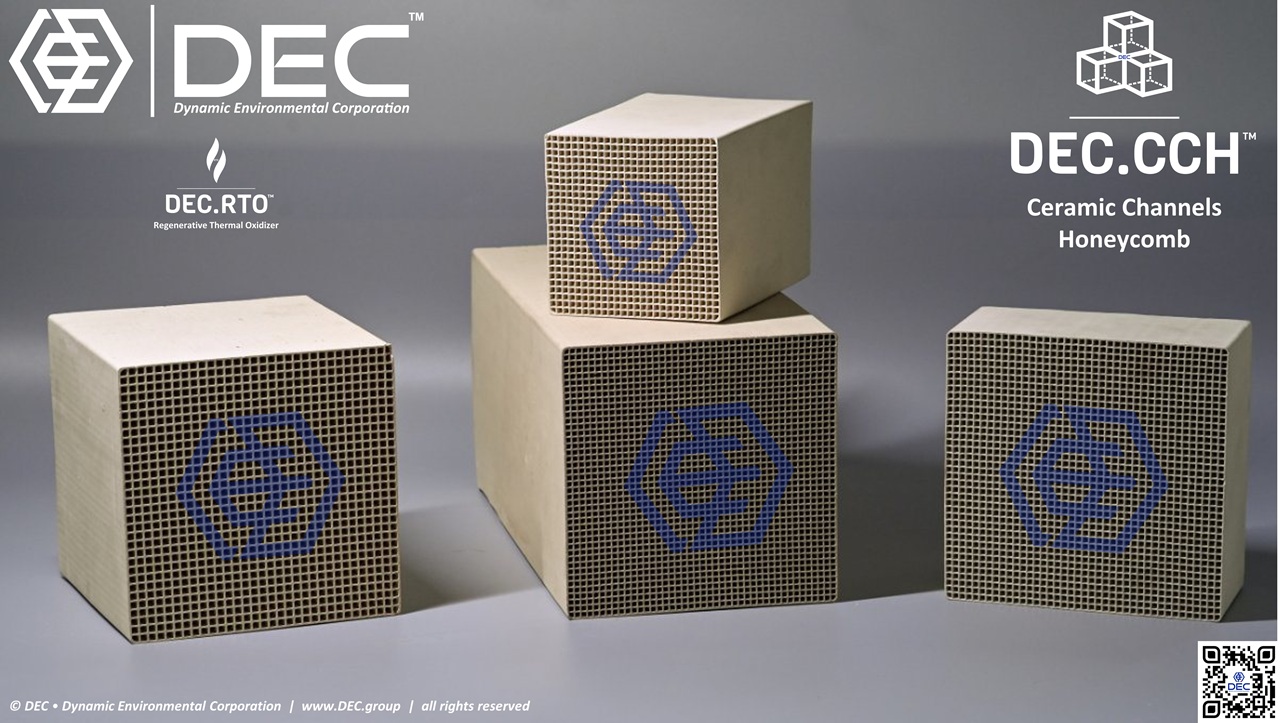
The Ceramic Channels Honeycomb (DEC.CCH™) is the core heat exchange medium in DEC.RTO™ (Regenerative Thermal Oxidizer) systems, engineered to maximize thermal recovery efficiency while maintaining controlled pressure drop across the media beds.
Manufactured from advanced ceramics such as cordierite or silicon carbide, the honeycomb structure consists of a dense array of parallel channels that enable highly efficient convective heat transfer between the solvent-laden air (SLA) and the thermal mass of the media.

key performances • Ceramic Channels Honeycomb DEC.CCH™
Maximizing Surface Area: DEC.CCH™ (Ceramic Channels Honeycomb) boasts a unique structure composed of numerous small channels or cells; this design maximizes the surface area available for heat transfer and reaction, allowing for efficient contact between the exhaust gases and the catalyst or heat storage media within the DEC.RTO™. The extensive surface area enables enhanced thermal efficiency and contributes to the effective removal of pollutants.
High-Temperature Resistance: RTOs operate at elevated temperatures to facilitate the oxidation of pollutants. DEC.CCH™ Ceramic Channels Honeycomb is specifically engineered using high-temperature resistant materials such as cordierite or silicon carbide. These ceramics exhibit exceptional thermal stability, withstanding the extreme conditions present within the DEC.RTO™ without significant degradation. Their durability ensures long-term reliability and minimizes maintenance requirements.
Heat Transfer and Energy Recovery: efficient heat transfer is crucial in RTOs to optimize the energy consumption of the system. Ceramic Channels Honeycomb facilitates effective heat exchange by storing and transferring thermal energy within its intricate network of channels. During operation, the hot gas flow is periodically reversed, allowing the stored heat to be recovered and transferred to the incoming exhaust stream. This process significantly reduces fuel consumption and overall operating costs, enhancing the sustainability of the DEC.RTO™.
Optimized Pressure Drop: specific hydraulic diameter, cell density (CPSI), wall thickness, and open frontal area (OFA), to obtain the best balance between Heat Transfer Efficiency vs. Pressure Drop.
Corrosion Resistance: industrial exhaust streams can often contain corrosive elements or compounds. Ceramic Channels Honeycomb exhibits excellent resistance to chemical corrosion, ensuring prolonged service life and consistent performance. The corrosion resistance properties of the ceramic material protect the honeycomb structure, maintaining its integrity and preventing potential leaks or system failures.
Competitive Differentiation • Ceramic Channels Honeycomb DEC.CCH™
The primary competitive differentiation for DEC lies not in the ceramic honeycomb itself, but in the sophisticated engineering of the entire system; emphasizing an high efficiency claims exceeding 98%, would fail to transparently address the associated pressure drop penalties and fan energy costs. A narrow focus on thermal recovery can lead to hidden operational burdens, as the Customer may face significantly higher electricity bills or long term fouling issues that were not initially disclosed. DEC provides a comprehensive analysis of the total cost of ownership (TCO), ensuring that the media configuration and bed height are tailored to the specific process conditions of the Customer; consequently, our approach prioritizes a balanced design where performance is sustainable and the trade off between fuel savings and electrical load is clearly optimized.
conclusion • Ceramic Channels Honeycomb DEC.CCH™
The DEC.CCH™ Ceramic Channels Honeycomb is a high-performance heat exchange medium that enables exceptional thermal recovery in Regenerative Thermal Oxidizers DEC.RTO™ systems. However, its true value emerges only when integrated within a carefully optimized system design.
The optimal RTO is not the one with the highest efficiency on paper, but the one with the lowest total energy cost in real operating conditions.