Solvent Recovery in the Coffee Decaffeination food processing industry
DEC.SRU™ ♻️ SRU | SRS | SRP
In the Coffee Decaffeination food processing industry, the direct-solvent process is a common and cost-effective method of decaffeinating coffee beans that involves the direct application of a chemical solvent to remove caffeine. This method is one of the oldest decaffeination techniques and remains popular for large-scale commercial production, with very high caffeine removal rate (up to 98%).
The mechanism used to decaffeinate the coffee beans is known as "solvation", a process where a solvent dissolves a solute (in this case caffeine). Following the rule "like dissolves like", substances with similar chemical properties (especially polarity) tend to dissolve in each other. Caffeine has some polar regions, and the solvent also has some polarity, which allows them to interact effectively. During solvation, the solvent and solute molecules are attracted to each other through weak intermolecular forces, such as dipole-dipole interactions. These attractions are strong enough to overcome the forces holding the solute molecules together in the coffee bean, pulling them into the solvent. As a result, the solvent draws the caffeine out of the coffee beans.
Ethyl Acetate (ETAC)
Today, Ethyl Acetate (ETAC) (C4H8O2) is a widely used solvent for this process. It's a colorless liquid with a fruity, sweet odor and is favored for its low toxicity. Many refer to it as a "natural" option because it's found naturally in ripening fruits (like bananas, apples, pineapples, peaches, and grapes) and in products like wine and beer. When coffee is decaffeinated with ETAC, it's often marketed as "naturally decaffeinated" or "Sugar Cane EA Decaf", as the solvent itself is frequently a byproduct of sugarcane processing. Because of its natural presence and low toxicity, both the U.S. Food and Drug Administration (FDA) and the E.U. Food Safety Authority (EFSA) classify ETAC as a "Generally Recognized As Safe (GRAS)" substance. While this means it's considered safe for use in food under specified conditions, it is highly flammable, which requires specialized equipment and careful handling.
Methylene Chloride (DCM)
Historically, Methylene Chloride (DCM) (CH2Cl2, dichloromethane) was the more common solvent used for this process. It is highly effective and selective, primarily targeting and removing caffeine while largely preserving the coffee's original flavor compounds and aromas. A secondary benefit of the DCM process is the removal of specific coffee waxes Nβ-alkanoyl-5-hydroxytryptamines (C-5-HT), which some studies suggest can contribute to stomach irritation. Thus, DCM-decaffeinated coffee may be easier to digest for some individuals. However, as a chlorinated compound, DCM presents significant health and environmental risks. It is classified as a probable human carcinogen and a potential toxin. It also poses a risk as a persistent organic pollutant that can contaminate groundwater. While there have been safety concerns in the past, both the U.S. and the E.U. have determined that the trace amounts that might remain in decaffeinated coffee are safe for consumption, setting specific Maximum Residue Levels (MRLs). However, its classification as a probable carcinogen has led many companies to shift away from it, particularly in Europe.
Regardless of which solvent is used, the final stage of the decaffeination process involves steaming the beans. Since both DCM and ETAC are highly volatile, they vaporize at temperatures well below the coffee roasting temperature. This final step ensures that very little, if any, solvent residue remains on the final roasted beans. According to industry standards, batches are sampled and tested to ensure that solvent residue levels meet all regulatory limits.
VOC Treatment
Industrial decaffeination facilities must have specialized systems to capture and treat the volatile organic compounds (VOCs) released from solvents like Ethyl Acetate (ETAC) and Methylene Chloride (DCM) before they are released into the atmosphere, to comply with applicable environmental directives.
why DEC?
As the industry leader, DEC has cultivated deep expertise in Solvent Recovery (SRU, SRS, SRP), tailored specifically for the Coffee Decaffeination food processing industry. Our aim is to provide innovative, value-driven solutions that meet your business needs while promoting a cleaner, greener environment.
Our Innovative Offerings
Leveraging decades of experience and a passion for innovation, we offer:
Coffee Decaffeination food processing industry, the VOC recovery challenge
Activated carbon is used to recover Ethyl Acetate (ETAC) or Methylene Chloride (DCM) solvent through adsorption, followed by desorption and condensation of the Ethyl Acetate (ETAC) or Methylene Chloride (DCM). The process typically involves passing the Ethyl Acetate (ETAC) or Methylene Chloride (DCM)-laden air stream through a bed of activated carbon, where the Ethyl Acetate (ETAC) or Methylene Chloride (DCM) is adsorbed onto the carbon's surface. The saturated activated carbon is then regenerated, which releases the Ethyl Acetate (ETAC) or Methylene Chloride (DCM) for recovery and reuse.
For the Coffee Decaffeination food processing industry, we offer different VOC recovery processes:
Selecting the SRU process is a decision based on several factors: regulatory requirements, the quantities involved, available utilities, the project's footprint, and the resulting cost-effectiveness.
The core advantage of DEC's SRUs lies in their ability to enable the direct reuse of recovered solvents. This paradigm shift from "destruction" to recovery yields substantial benefits across multiple dimensions of sustainability:
Economic Advantages
Environmental Advantages
Achieve Superior Solvent Recovery and Environmental Compliance with DEC Advanced Solutions
Our state-of-the-art Solvent Recovery technologies are meticulously designed to maximize the yield of recovered solvents while dramatically lowering VOC emissions, ensuring compliance with the most stringent regulations. This strategy promotes optimal resource use, significant cost savings, and a substantial reduction in your environmental footprint.
By harnessing our years of experience and relentless pursuit of innovation, we have developed a comprehensive range of Solvent Recovery solutions modular (SRU_SMS™ • series) or tailor-made (SRU_CBS™ • series) for the unique challenges faced by Coffee Decaffeination food processing industries. Our state-of-the-art technologies ensure optimal recovery and purification of solvents, allowing you to maximize your resources, reduce costs (savings), and minimize environmental impact.
Partnership with DEC
Choosing DEC means embarking on a journey towards sustainable success. Our expert team is here to tailor solutions that integrate perfectly with your operational needs, fostering enduring partnerships built on trust and mutual growth.
Making a Difference Together
Join us in revolutionizing Solvent Recovery with DEC.SRU™: together, we can drive change towards a more efficient and eco-friendly future.
a sustainable choice: Solvent Recovery applications in Coffee Decaffeination food processing industries
Solvent Recovery Units (DEC.SRU™), also known as Solvent Recovery Systems (SRS) or Solvent Recovery Plants (SRP), are devices used to recover solvents from air emissions of Coffee Decaffeination food processing industries.
Solvents are used in a variety of industrial processes, including expandable polystyrene (EPS), and can be harmful to human health and the environment if released into the air. SRU systems work by capturing the solvents from the air emissions and then recycling them back into the production process. This helps to reduce air pollution and can also save businesses money on the cost of solvents (ROI).
Solvent Recovery Units (DEC.SRU™) dedicated to Coffee Decaffeination food processing industries are the best solution to reduce solvent emissions (VOCs) in a sustainable way: no thermal oxidation, no CO2 (DECarbonization).
The solvent is recovered, for direct reuse, at a fraction of its purchase cost and with a purity even higher than the fresh virgin solvent or for disposal.
how it works? Solvent Recovery Units (SRU | SRS | SRP)
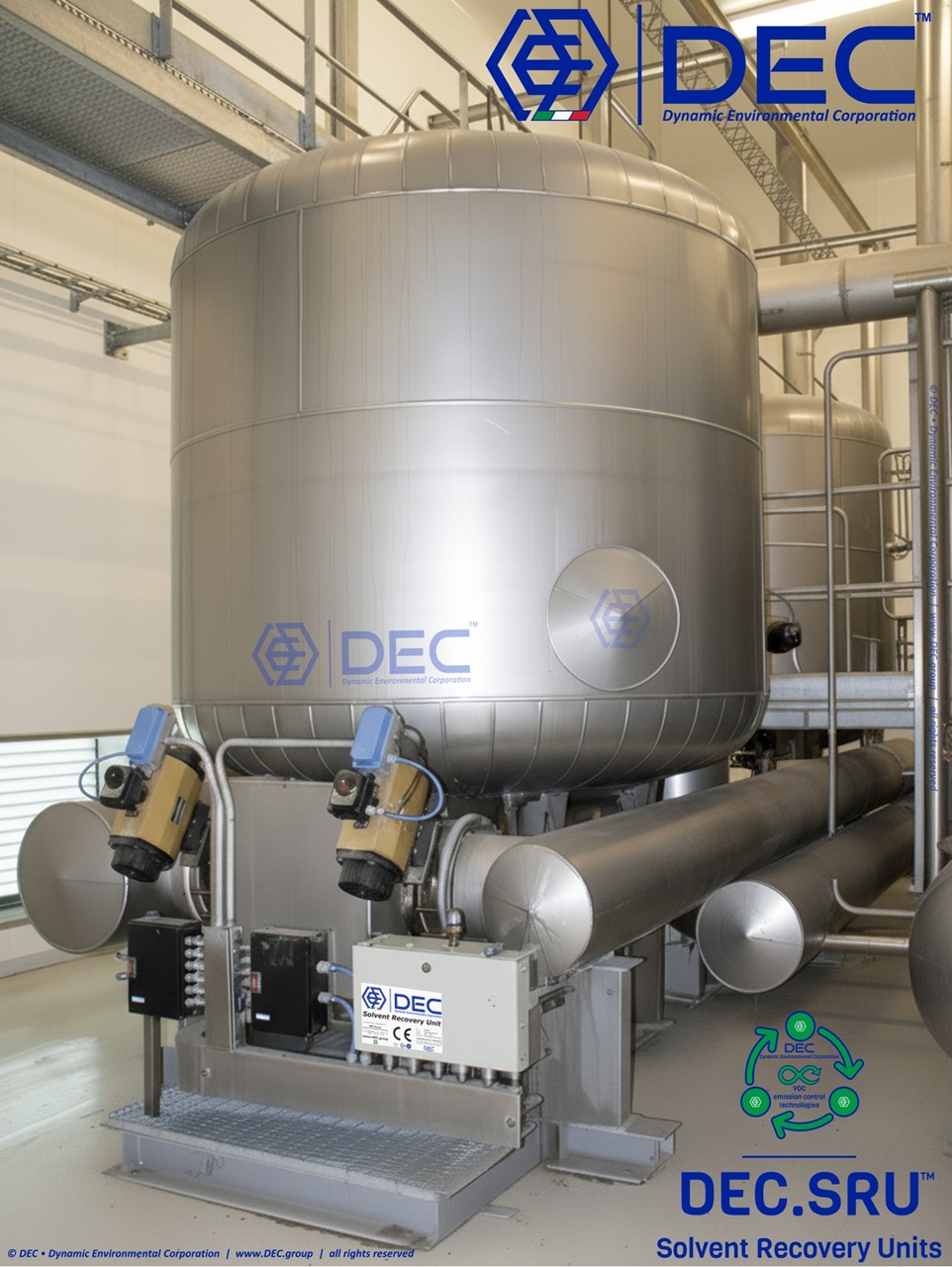
SLA (Solvent Laden Air) is pushed by the fans through a multi-adsorber (activated carbon) system, to allow a high efficiency VOC (Volatile Organic Compounds) capture.
Once the adsorbent is saturated (automatically monitored by a VOC analyzer), the system is automatically cleansing the adsorbent, through a regeneration cycle. The system is using an exclusive DEC.PHD™ dehydration process (in gaseous phase), allowing the direct recovery of an anhydrous solvent mix.
For further info: DEC.RSG™ activated carbon Solvent Recovery systems for pharmaceutical industries, nitrogen regeneration.

savings and return of investment: Solvent Recovery Units (SRU | SRS | SRP)
Solvents used in the Coffee Decaffeination food processing industries represent a significant cost: DEC Solvent Recovery Units ♻️ SRU | SRS | SRP provide a valuable return on investment by capturing these solvents for direct reuse in the process, leading to reduced operating expenses and improved competitiveness.
To remain competitive and profitable, Coffee Decaffeination food processing industries must prioritize sustainability. Solvent Recovery Units minimize waste, significantly reduce CO2 emissions (potentially to zero), and offer a proactive approach to mitigating the potential impact of future carbon taxes.
To remain competitive and profitable, Lead Acid Battery Separators companies must prioritize sustainability. Solvent Recovery Units minimize waste, significantly reduce CO2 emissions (potentially to zero), and offer a proactive approach to mitigating the potential impact of future carbon taxes.
Recent advancements in process technology have significantly reduced the energy required for activated carbon regeneration (up to 40%), leading to a substantial decrease in operating costs.
Industry Relevance: the Coffee Decaffeination food processing industry
The Coffee Decaffeination food processing industry remains a cornerstone in various sectors, from construction and packaging to automotive and insulation. However, its continued growth and viability are increasingly tied to its ability to navigate a complex landscape of stringent environmental regulations. This includes not only addressing the end-of-life challenges of EPS products, such as developing effective recycling streams and promoting circular economy principles, but also minimizing the environmental footprint of the manufacturing process itself. Adhering to these regulations is no longer just a compliance issue; it has become a critical factor for market access, brand reputation, and long-term sustainability within the global EPS industry.
Explore More
Visit our site to see how DEC Solvent Recovery Units (SRUs) can revolutionize your production. Discover how our technology can enhance your efficiency, lower costs, and lead the way in sustainable practices within the Coffee Decaffeination food processing industry.
contact DEC
If you are looking for a reliable and efficient Solvent Recovery Unit, DEC.SRUs™ (Solvent Recovery Units) are the right and best option: DEC.SRUs™ are the most advanced and reliable Solvent Recovery Units on the market, with processes, configurations and options to meet the needs of different applications, present and future challenges. Feel free to contact DEC: we can help you assess your needs and recommend the best SRU for your operation.
LTKW
At DEC, our cutting-edge activated carbon technology is meticulously designed to optimize the coffee decaffeination process. Our activated carbon solvent recovery for ethyl acetate or methylene chloride is the definitive choice for food processors seeking to enhance efficiency and sustainability. We specialize in providing the most reliable activated carbon solvent recovery units and industrial decaffeination equipment for the efficient capture and reuse of solvents. Whether you need an in-depth understanding of the activated carbon decaffeination process explained or are looking for a detailed comparison of decaffeination processes, our resources are here to help. For those ready to upgrade their operations, we offer turnkey solvent recovery solutions, providing detailed information on activated carbon solvent recovery system price and the methylene chloride recovery plant cost. We also provide solutions for other key operational aspects, including adsorption technology in coffee decaffeination, VOC emission control food industry, and activated carbon regeneration for solvent recovery. Our DEC solutions are unmatched, from ethyl acetate solvent recovery system suppliers to custom solvent recovery plant DEC designs.