Advancing VOC Emission Control in Automotive industries
Best Practices and Environmental Considerations
The automotive industry, including the rapidly expanding sector of battery gigafactories, generates substantial Volatile Organic Compound (VOC) emissions from solvent-based coating, painting, and electrode manufacturing processes. Regulatory compliance, environmental responsibility, and operational economics demand a proven, application-specific solution.
The Automotive sector involves the processing of materials through coating stages that use solvents to apply functional layers. These include protective finishes, decorative lacquers, and the critical slurry coatings used in lithium-ion battery production within gigafactories.
Volatile Organic Compounds (VOCs) are a major source of air pollution, contributing to smog, and ground-level ozone formation. VOC emissions also show harmful effects on human health, causing respiratory problems and other health effects. Globally, typical pollutants found in automotive manufacturing and battery production include:
- esters such as ethyl acetate (ETAC), n-propyl acetate (n-PA, NPAC), isopropyl acetate (IPAC), and methyl acetate (MEAC);
- carbonates such as dimethyl carbonate (DMC);
- ketones such as methyl ethyl ketone (MEK);
- lactams such as N-Methyl-2-pyrrolidone (NMP);
- alcohols, as co-solvents, such as Ethanol, Isopropanol (IPA, IPOH), n-Propanol (NPOH), Butanol / isobutanol;
- aromatics, as viscosity reducer, such as toluene (TOL), Xylene (XYL);
- inorganics, in traces, such as hydrogen fluoride (HF).
Air Pollution Control systems like SRU™ • Solvent Recovery Units, RTO™ • Regenerative Thermal Oxidizers eventually coupled with RBC™ • Rotary Bed Concentrators are designed and tuned to handle the specific solvent profiles of each automotive application. The technical requirements for VOC abatement vary depending on the specific end product and the chemical composition of the coatings used. DEC tailors every APC system to meet the unique needs of the Customer.
Advanced VOC Emission Control for Automotive and Gigafactory Applications
The automotive manufacturing industry faces significant environmental challenges due to the high volume of VOCs released during painting, coating, and battery electrode drying. DEC provides industry-leading advanced APC systems. These technologies ensure that the Customer remains compliant with strict global emission standards while optimizing operational efficiency.
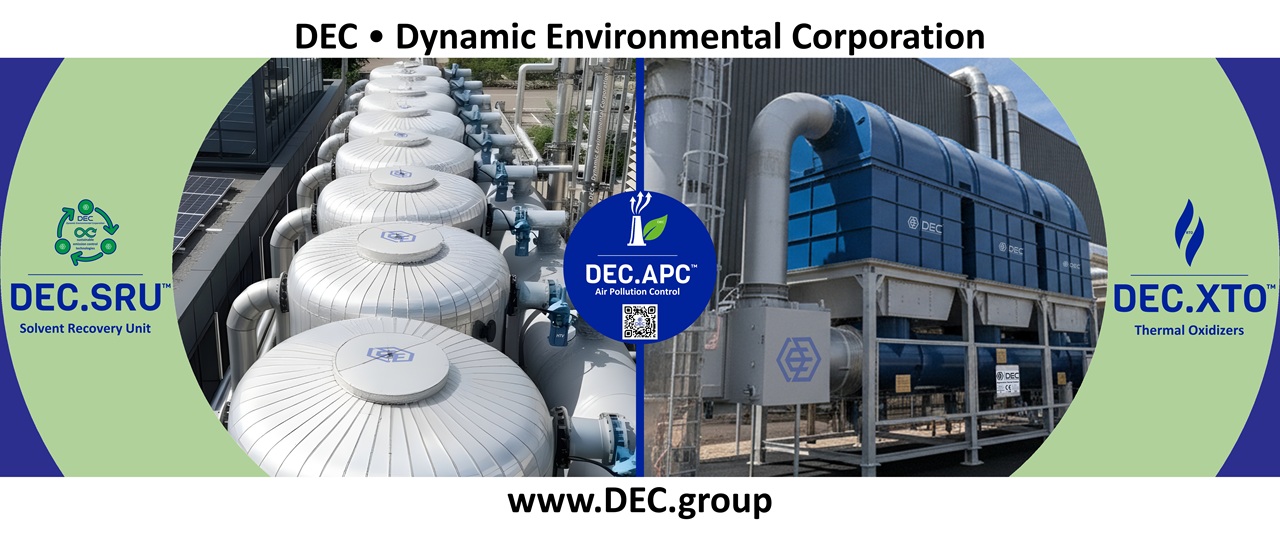
There are three main VOC emission control technologies that can be used in Automotive manufacturing, to comply with environmental regulations. The best-performing technologies include:
SRU™ • solvent recovery units
SRU, Solvent Recovery Unit (also known as SRP, Solvent Recovery Plant) is a gas phase VOC adsorption system, based on activated carbon, complete of onsite desorption technology, typically employed as VOC Emission Control, allowing to respect VOC emission limits with a typical efficiency up to 99%, while recovering the solvents for direct reuse, at a fraction of their purchase cost, generating a very interesting ROI (a sustainable technology and a true path to decarbonization). They can cover from small to large SLA (solvent-laden air) volumes and deal with a wide variety of VOCs, including water-miscible, non-water-miscible solvents.
RTO™ • Regenerative Thermal Oxidizers
RTO, Regenerative Thermal Oxidation works by burning VOCs at high temperatures in a closed combustion chamber: through the oxidation reaction VOCs are converted to GHG (green house gases, CO2, NOX, CO, and H2O). The heat generated during the combustion process is then captured and used to preheat incoming air (SLA, solvent-laden air), which in turn reduces fuel consumption and enhances energy efficiency compared to traditional thermal oxidation methods. The multi-tower design of RTO allows for continuous operation and a Destruction Removal Efficiency (DRE) exceeding 99%.
RBC™ • Rotary Bed Concentrators
RBC, Rotary Bed Concentration works by utilizing a rotating honeycomb wheel impregnated with adsorbents; typically hydrophobic zeolites; to continuously concentrate VOCs from high-volume, low-concentration exhaust air. As the contaminated air passes through the rotating bed, the VOCs are captured on the adsorbent material while the cleaned air is discharged to the stack. A smaller, heated stream of air then passes through a separate desorption sector of the wheel; this process releases the concentrated VOCs into a much smaller air volume, which is subsequently re-directed to an SRU for recovery or an RTO for destruction.
- Rotor Concentrator, upstream version: aimed at reducing fugitive emissions, optimizing capture at the source.
- Rotor Concentrator, downstream version: dedicated to reducing emissions at the stack, ensuring compliance with the most restrictive emission limits.
For more complex flows, the DEC.HSU™ • Hybrid Sorption Unit process combines above processes and technologies to maximize abatement efficiency, offering a hybrid solution that perfectly meets the requirements of the Customers.
Additional ancillary systems further protect the core APC equipment: XSU™ • Wet & Dry Scrubber Units remove particulate matter and acidic gases upstream of the main treatment system, while AFU™ • Adsorbent Filtering Units act as guard beds and concentration buffers, shielding the downstream processes from contaminants and smoothing out VOC load fluctuations.
Environmental Regulations - VOC emission control
VOC emission control is mandatory in several countries, with specific limits at the stack of every industry. Below we will cover the main codes for the automotive sector.
The Industrial Emissions Directive (IED) is a European Union directive that sets limits on VOC emissions from industrial processes. The IED includes a Best Available Techniques (BAT) Reference Document (BREF) for the automotive sector, which outlines the best practices for controlling VOCs.
The US Clean Air Act (CAA) is a federal law that regulates air pollution in the United States. The CAA includes a number of provisions that address VOC emissions.
Specialized Solutions for Specific Automotive Applications
- Vehicle Coating and Painting: high-volume lines for primers, basecoats, and clearcoats;
- Gigafactories (Battery Production): use of NMP (N-Methyl-2-pyrrolidone) during the electrode coating and drying process;
- Parts Manufacturing: specialized coating for interior and exterior components.