The history of Activated Carbon • from ancient medicine to air pollution control
A Historical Timeline
The history of adsorption on carbon is a rich and diverse one. The ability of charcoal to remove impurities has been exploited since ancient times, and at the beginning of the 20th century the development of activation processes turned it into activated carbon, an engineered adsorbent.
From its earliest medicinal applications to its role in Air Pollution Control (e.g. Solvent Recovery), carbon adsorption has played a significant role in many industries throughout history.
Ancient times
The use of charcoal, the forerunner of activated carbon, dates back to antiquity. Around 1500 B.C., Egyptian papyri recorded the use of charcoal to adsorb the unpleasant odors of putrefying wounds and to treat intestinal ailments: the first documented medical application of carbonaceous adsorbents.
Charcoal was also used to purify water: Hindu documents from around 450 B.C. record the use of charcoal and sand filters for drinking water, and by around 400 B.C. Phoenician traders were storing water in charred barrels on their ships to improve its taste.
In the 4th century B.C., the Greek physician Hippocrates is reported to have used charcoal to treat a variety of ailments, and in the 1st century A.D. the Roman author Pliny the Elder also described its medicinal uses.
18th century
The adsorptive properties of charcoal, the forerunner of activated carbon, were discovered and investigated in the late 18th century: in 1773, Carl Wilhelm SCHEELE (Sweden) reported observations concerning the adsorption of gases by charcoal, representing one of the earliest scientific investigations of gas-phase adsorption. [1]
In 1785, Johann Tobias LOWITZ (Russian Empire) investigated adsorption on charcoal in the liquid phase, studying the decolorization of solutions and the removal of bad taste and odors from water, and suggested its use for practical applications.
The first industrial application followed shortly after: in 1794, charcoal was applied to the refining of sugar, and during the 19th century charred animal bones (bone char) became the standard decolorizing adsorbent of the sugar industry, the first large-scale industrial use of adsorption on carbon.
19th century
Alongside the sugar industry, the adsorption of gases and vapors on charcoal moved from the laboratory to the first practical devices.
In 1854, John STENHOUSE (United Kingdom) built one of the first charcoal respirators, filtering inhaled air through a layer of powdered wood charcoal. In 1865, John HUNTER (United Kingdom) showed that charcoal made from coconut shell had an exceptional capacity for gases and vapors ("On the absorption of vapours by charcoal", Journal of the Chemical Society), and in 1881, Heinrich KAYSER (Germany) introduced the term "adsorption" to describe the uptake of gases on the surface of charcoal.
In 1898, the Compagnie du Gaz Riché S.A. was established in Paris to exploit the wood-distillation gas process of engineer Henri RICHÉ (France), an ingénieur des arts et manufactures and teaching assistant at the École Centrale. The process was based on "reversed distillation": wood was carbonized in closed cast-iron retorts, and the distillation gases were forced through a column of red-hot charcoal, producing a fuel gas rich in hydrogen and carbon monoxide, together with high-quality charcoal as a by-product, without tar residues. Industrial trials in 1898 at the Scierie française de Calais showed that 1,362 kg of waste wood produced 208.5 kg of charcoal and enough gas to drive a 55 hp engine for 20 hours, turning sawmill waste such as shavings and sawdust into power. The company exhibited the process at the 1900 Paris Exposition Universelle, and by the early 1900s Riché gas producers had been installed in 42 plants, totaling nearly 3,000 hp, in France and abroad.
The work of these scientists and engineers laid the scientific and industrial foundations of adsorption on carbon: it showed that charcoal could adsorb a wide range of gases, vapors and dissolved impurities, and that its performance depended on the raw material and on how it was produced. Turning charcoal into a true activated carbon, with a controlled porous structure, became the task of the activation processes patented at the beginning of the 20th century.
20th century
Around 1900, the patents of chemist Raphael von Ostrejko (Russian Empire) laid the foundations for the industrialization of activated carbon production, defining the two activation routes still used today: chemical activation, carbonizing vegetable raw materials in the presence of metal chlorides, and physical activation, treating charred material with superheated steam or carbon dioxide at high temperature. His patent granted in the United States, "Process of obtaining carbon of great decolorizing power" (No. 739,104, filed 4 January 1901, granted 15 September 1903), describes steam and carbon dioxide activation of wood charcoal, and also notes that used carbon can have its adsorption capacity restored by the same process, an early statement of activated carbon regeneration. The process was intended mainly for carbons used in sugar refining and liquid decolorization.
The first large-scale use of activated carbon for gas-phase adsorption came in 1915, when activated carbon filters were introduced in gas masks during World War I to adsorb harmful and poisonous chemicals, replacing the plain charcoal used in respirators since the 19th century. Its effectiveness was confirmed during World Wars I and II, protecting soldiers from chemical warfare agents and firefighters from toxic fumes, and it established gas-phase adsorption as an industrial technology, the basis of later Solvent Recovery.
 |
 |
In the 1920s, Aldo VOLPINO (1894–1971 – Regio Istituto Tecnico Superiore, Milano) founded the Anticromos® plant in Legnago (Verona, Italy), one of Europe's earliest activated carbon industrial manufacturers, based on his patent for carbonizing wood through an early form of chemical activation. The resulting activated carbon was used to adsorb solvents and purify glucose, seed oils, and wine without altering the properties of the treated products, with wineries serving as its main customers.
At the same time, S.R.E.P. (Société de Recherches et d'Exploitations Pétrolifères, part of the Groupe Empain, founded in 1881) began exploiting France's first commercial natural gas fields at Vaux-en-Bugey (Ain). To degasoline (dégazoliner) and purify the raw gas, recovering natural gasoline condensates, S.R.E.P. required activated carbon, which it initially imported at high cost from Anticromos®. To eliminate steep import expenses and secure a domestic supply, S.R.E.P. developed its own activation process and proprietary kiln design at Vaux-en-Bugey in 1924 under the ACTICARBONE® brand, and by 1926 was already patenting annular-bed activated carbon adsorber vessels (French Patent No. 612,386 and Patent of Addition No. 33,081) for industrial gas and vapor recovery.
At the forefront of this French industrial scale-up, engineer Albert André GODEL (1896–1974 – École Centrale des Arts et Manufactures, Paris) helped transition activated carbon from laboratory chemistry to large-scale vapor-phase adsorption. Working first with S.R.E.P. as Director of the Acticarbone® division, and from 1934 as founder of ACTIVIT in Paris, Godel pioneered continuous manufacturing processes and fluidized-bed gas-solid activation techniques. Developed jointly with CECA, these innovations helped lay the foundation for modern activated-carbon-based Air Pollution Control (APC) plants.
Growing internal demand and expanding industrial adsorption applications led S.R.E.P. to spin off its activated carbon operations in 1928 by incorporating CECA • Carbonisation Et Charbons Actifs (FR). In 1945, during post-war industrial reconstruction, CECA consolidated European activated carbon manufacturing by acquiring Anticromos®, whose corporate headquarters were based in Milan alongside its Legnago plant, uniting the French Acticarbone®/GODEL technological lineage with Anticromos®/VOLPINO's Italian manufacturing heritage and transforming Legnago into CECA's main Southern European production site.
Parallel to this continental expansion, British scientist and chemical executive Samuel Reginald PRICE (1889–1966 – University of Cambridge, UK), Technical Director of the CECA Acticarbone® Section at London-based Price, Stutfield & Co., Ltd., spearheaded the introduction of ACTICARBONE® vapor-phase adsorption and solvent recovery plants into the United Kingdom and the British Commonwealth. Through landmark technical papers published in The Industrial Chemist (1930) and The Chemical Age (1933), widely abstracted across European chemical literature such as Chemisches Zentralblatt, Price documented how fixed-bed activated carbon systems could capture and regenerate volatile solvents such as benzol, gasoline, and industrial spirits across the rubber, rayon, and dry-cleaning industries.
Meanwhile, within Milan's chemical and activated-carbon engineering milieu, DEC • Dynamic Environmental Corporation (formerly known as Depurazione di Emissioni per l'Industria Chimica, Depurazione Emissioni Convogliate, DEC Impianti, Italy) was incorporated in 1946 by Angelo GIORGETTI (1907–1987 – Regio Istituto Tecnico Superiore, Milano). Bridging the upstream foundations laid by both pioneers, the Giorgetti-Sassi family drew directly on early technical advice from Aldo VOLPINO in Milan while applying the gas-phase activated carbons and vapor-phase adsorption principles shaped by Albert GODEL and CECA to pioneer downstream industrial Solvent Recovery and Air Pollution Control (APC) systems.

In the 1960s and 1970s, environmental regulations such as the US Clean Air Act led to increased focus on air pollution control. Activated carbon emerged as an essential tool for controlling VOC emissions from automotive (EVAP • Evaporative Emission System) and industrial facilities (SRU process).
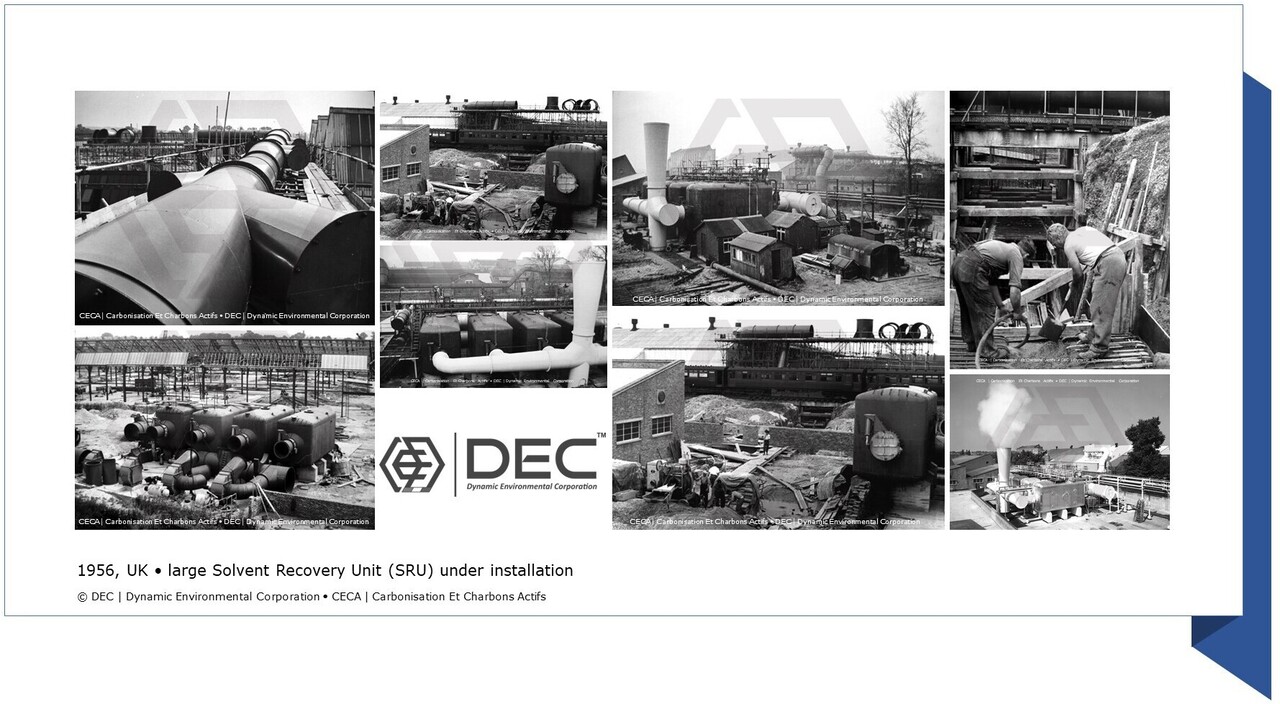
In 1988, Peabody International Corporation® transferred its activated carbon Solvent Recovery Unit (SRU) division—along with its know-how, intellectual property, and project references—to DEC (DEC Impianti). This business traced its gas-treatment engineering roots to CECA (Carbonisation Et Charbons Actifs), which had merged its anti-pollution division (Département Entreprises – TG, Traitement de Gaz) into Peabody GCI in 1980. Through this transition, DEC assumed the installed customer base of gas-phase adsorption units built under CECA and Peabody GCI, inheriting their full track record as well as the associated engineering, construction, and service operations (including revamping and retrofits) for large industrial VOC recovery units.
Alongside the 1988 transfer, DEC established a strategic relationship with CECA's adsorbents business, which had remained outside the 1980 engineering divestment to Peabody GCI and was subsequently acquired by Elf Aquitaine in 1981. CECA's adsorbents activities subsequently evolved within the wider French chemical industry through successive corporate reorganisations, including the Atochem, Elf Atochem and Atofina periods, before the emergence of Arkema. This relationship combined two complementary areas of expertise: CECA's development, manufacturing, and supply of specialized adsorbent media—including activated carbon and molecular sieves—and DEC's engineering of process applications, industrial recovery plants, and advanced on-site adsorbent regeneration systems.
Together, this industrial collaboration and inherited engineering heritage reinforced DEC's technological capabilities, providing the material and process foundations for the continued advancement of its solvent recovery systems and its present commitment to innovative, sustainable technologies and research addressing global sustainability and decarbonization challenges.
Building on this foundation, DEC established itself as a leading global supplier of industrial VOC emission control systems with solvent recovery. DEC's SRU systems are engineered to capture and recover volatile compounds for direct reuse in production, the most resource-efficient circular solution for industries generating high-volume organic solvent emissions. DEC has also pioneered proprietary advancements in on-site regeneration technologies (including RSV™ • TSA steam, RSG™ • TSA inert gas N2, and RTV™ • T+VSA vacuum), further improving operational cost-effectiveness and environmental performance.
Present
Today, DEC • Dynamic Environmental Corporation brings together this accumulated heritage in industrial Air Pollution Control (APC). The starting point is no longer a standard equipment package: it is the emission stream itself. DEC analyzes process conditions, pollutants, treatment objectives and applicable requirements, then engineers the most appropriate pathway to recover, concentrate, oxidize, treat or recover energy.
Activated carbon remains at the core of this expertise. DEC's Solvent Recovery Units (SRU) capture valuable VOCs from process exhaust for reuse, using inert gas (RSG™), steam (RSV™) or vacuum (RTV™) regeneration. Where recovery is not technically or economically appropriate, dilute streams can be pre-concentrated with XBC™ concentrators, and non-recoverable VOCs and HAPs destroyed in XTO™ thermal oxidizers. Where process conditions allow, ERS™ energy recovery turns heat into usable energy.
This hybrid approach, combining technologies when a single treatment step is not enough, serves industries such as flexible packaging, converting and coating, chemical, petrochemical and pharmaceutical, across solvent-laden air flow rates from about 200 to 1,000,000 m³/h. Each system is engineered around measurable abatement objectives and the regulatory framework of the installation site.
With 2,500+ projects delivered in 50+ countries, DEC follows a turnkey EPC model, from process assessment and feasibility analysis through engineering, installation and acceptance testing to lifetime technical support, backed by its global network. Where the stream is suitable, solvent recovery turns emissions into economic, environmental and operational value: the Triple Bottom Line.
Conclusions
The story of charcoal and then activated carbon runs from ancient medicine, where it was used to treat wounds, intestinal ailments, and purify water, to the modern industrial processes that depend on it. Its power to adsorb impurities, and to be regenerated and reused, has made it a lasting answer to cleaner air and efficient solvent recovery, in industries from packaging and coating to chemical and pharmaceutical production.
DEC carries that heritage forward as an engineering company: it starts from the actual emission stream and selects, or combines, the technology that fits it, from solvent recovery and concentration to oxidation and energy recovery. To discuss your own process, contact DEC's technical team or explore our references.
Trademarks
Disclaimer: all trademarks, trade names, service marks, and corporate names referenced in this website are the property of their respective owners and are used strictly for historical identification and archival reference purposes.
References
- Scheele, C. W.Chemical Observations and Experiments on Air and Fire.